

NASCAR sponsorship ROI is the total business return a brand earns across broadcast media value, digital and social outcomes, B2B hospitality pipeline, consumer brand lift, and direct commercial sales, measured against the combined cost of rights and activation.
Most brands measure only one or two of those pillars, and in doing so they systematically understate the NASCAR sponsorship return on investment their money actually produced. Getting it right starts with treating return as a five-part question rather than a single headline number – which is where a specialised NASCAR sponsorship agency earns its place.
Broadcast media value for a competitive Cup Series primary sits in the region of $5M to $15M per season, a useful anchor but only the first line of the ledger. This guide sets out how to measure NASCAR sponsorship ROI in full: the five-pillar framework, the formula that ties it together, the benchmarks that tell you whether you are winning, and the measurement errors that quietly destroy reported NASCAR sponsorship ROI.
TL;DR – The Five-Pillar NASCAR Sponsorship ROI Framework
- Broadcast media value – Joyce Julius VTOC, Nielsen QI valuation, Relo Metrics viewability; Cup primary generates $5M–$15M equivalent media value per season
- Digital and social ROI – referral traffic, conversion, and engagement tracked via UTM-tagged URLs and attribution models across team-owned channels
- B2B hospitality and pipeline value – Thursday-to-Sunday race weekends, up to four days of qualified buyer access per event, attributable deal tracking via CRM
- Consumer brand lift – awareness, consideration, recall, purchase intent; NASCAR fans recall sponsor logos at higher rates than equivalent TV advertising (Levin, Joiner & Cameron, 2001)
- Direct commercial outcomes – sales lift, retail activation, promo-code redemption, and shareholder value; 24 NASCAR sponsors saw mean wealth increases of over $300M net of costs (Pruitt, Cornwell & Clark, 2004)
Sound NASCAR sponsorship measurement reads all five against rights plus activation – not one pillar against rights alone.
How is NASCAR sponsorship ROI measured?
NASCAR sponsorship ROI is measured by quantifying returns across five distinct pillars, then dividing total return by total investment – where investment includes both the rights fee and the activation spend.
That definition matters because the two most common failures hide inside it: measuring a single pillar, and leaving activation out of the denominator.
It is also worth separating two terms. Return on investment (ROI) is the percentage return on money spent. Return on sponsorship investment (ROSI) is Nielsen’s weighted variant, applying a strategic performance factor so non-monetary objectives are not lost in a purely financial read.
Neither works retrospectively. Measurement has to be designed into the deal before signing, because pillars that cannot be baselined before the season cannot be attributed cleanly after it. Practitioners consistently report that brands entering with a framework in place record materially higher returns than those measuring after the fact.
In short, how to measure NASCAR sponsorship ROI is a question answered before the contract is signed, not after the season ends – and getting that sequence right is most of the battle. Anyone who asks how to measure NASCAR sponsorship ROI once the season is over has already lost the baseline that makes a clean NASCAR sponsorship return on investment figure possible.
The Five-Pillar NASCAR Sponsorship ROI Framework
Understanding how to measure NASCAR sponsorship ROI starts with accepting that NASCAR is structurally different from the sports that generic sponsorship measurement was built around.
- The broadcast format spreads a single brand across a three-to-four-hour green-flag window rather than a series of discrete plays
- The calendar runs long, across a 36-race schedule (2026 NASCAR Cup Series schedule)
- Race weekends stretch Thursday to Sunday
- Fan loyalty converts into measurable purchasing behaviour
- The inventory, from the hood to the quarter panels, is priced in a way with no clean equivalent in ball sport
This is why NASCAR sponsorship media value has to be read on its own terms. Apply a generic framework to that structure and the NASCAR sponsorship return on investment reads low. The five pillars below are the practical answer to how to measure NASCAR sponsorship ROI without that distortion.
Pillar 1 – Broadcast Media Value
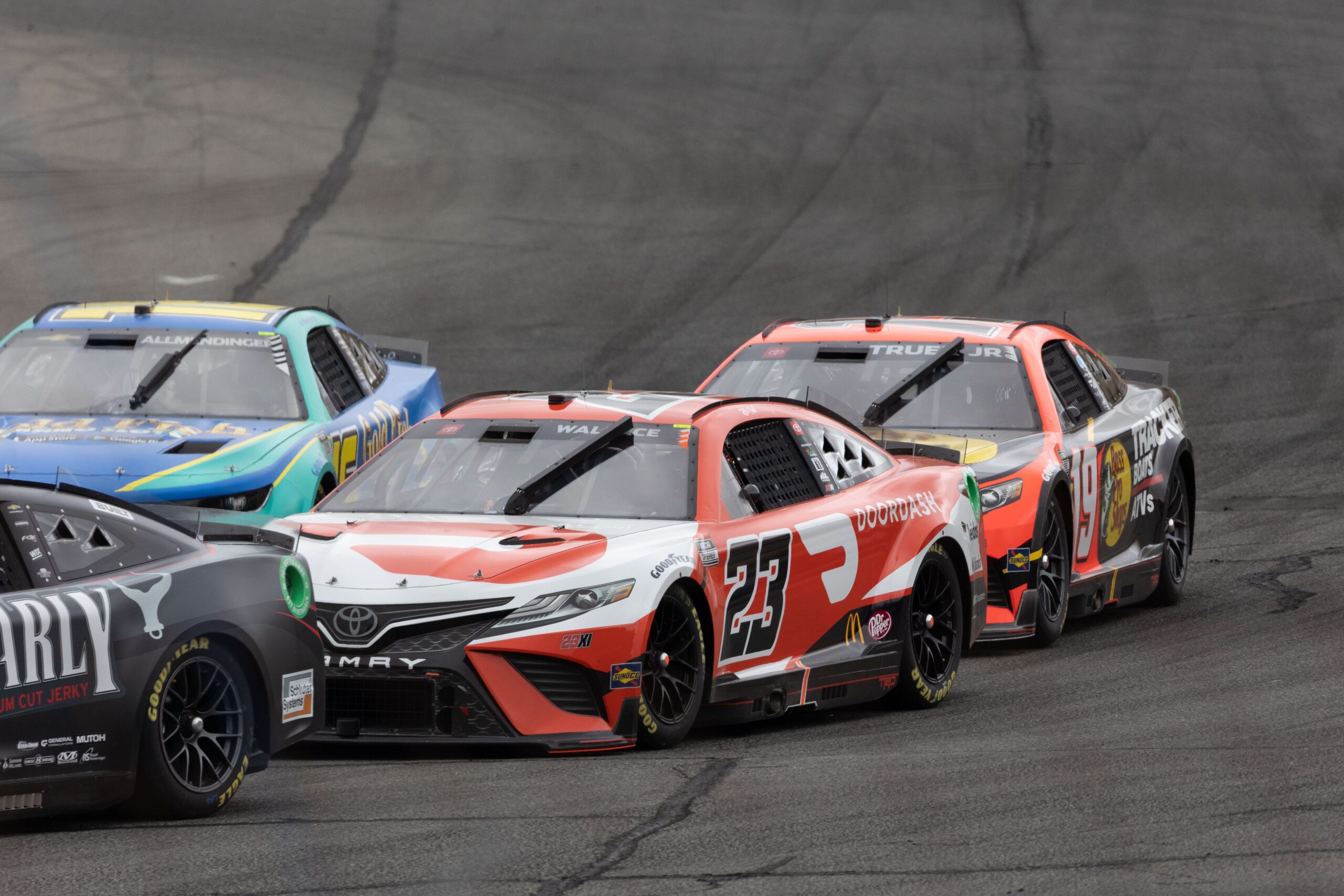
NASCAR sponsorship media value is the equivalent advertising cost of the on-screen exposure a brand earns across a race broadcast. It is the oldest and best-understood pillar, and for years it was the only one brands tracked.
Joyce Julius and Associates, founded in 1985, remains the long-standing reference point for NASCAR media measurement through its Value of Time on Camera (VTOC) method – which counts clear, in-focus brand exposure alongside verbal mentions, each valued as a fixed increment of advertising time based on roughly three brand mentions per thirty-second commercial (Applied Economics / Tandfonline).
Nielsen Sports offers a comparable global valuation using its proprietary QI Score methodology. Relo Metrics adds an AI-driven read on broadcast viewability.
What the numbers look like
For a competitive Cup primary, NASCAR sponsorship media value across the season lands broadly in the $5M to $15M range, spread across Fox, NBC, Amazon Prime Video and TNT Sports over 36 race weekends
Two adjustments keep the number honest:
- Viewability: Relo Metrics’ NASCAR viewability research found that on average 20% of broadcast frames suffer from blurriness due to race pace – exposure that is not legible should not be valued as if it were.
- Driver performance: Time on camera scales with results, laps led and fan-favourite status. Relo found broadcast cameras focus on the top ten drivers for nearly 50% of each race, so the same inventory delivers different NASCAR sponsorship media value depending on how the season goes.
A serious read adjusts for both rather than reporting a single unweighted exposure figure.
Pillar 2 – Digital and Social ROI
Digital and social ROI is the referral traffic, engagement, conversion and impression value generated from team-owned and series-owned channels across the contract period.
Cup teams carry combined social audiences in the millions across Instagram, X, Facebook, YouTube and TikTok, and a primary sponsor earns dedicated team content across every race weekend in the contracted programme.
This pillar is tracked, not estimated: UTM-tagged campaign URLs, dedicated landing pages, social analytics platforms and attribution models that treat the driver and team as an influencer channel. Sound NASCAR sponsorship measurement keeps this pillar separate from broadcast media value rather than folding one into the other, because the two answer different questions.
Why it deserves independent tracking
Brands that measure digital ROI on its own consistently find that the two figures together – digital plus broadcast – already exceed the headline sponsorship cost at the primary level, before the remaining three pillars are counted at all. Treating digital exposure as a sub-line of media value hides that.
The fix is to attribute traffic and conversion to the sponsorship directly, through tagged links and dedicated pages, rather than inferring it.
Pillar 3 – B2B Hospitality and Pipeline Value
Hospitality ROI is the attributable B2B pipeline value generated from race-weekend client entertainment, paddock access and on-site meetings – and it is where NASCAR’s calendar becomes a structural advantage.
A Thursday-to-Sunday race weekend delivers up to four days of qualified buyer time per event, more than any single match day in US sport, and primary sponsors typically receive six to eight garage hot passes per weekend to put clients inside the operation.
How to measure it
The measurement method is disciplined rather than anecdotal:
- Tag every guest invited to a NASCAR hospitality event in the CRM
- Track deal velocity among those NASCAR-touched accounts over the following four to six months
- Calculate the pipeline value attributable to those touchpoints
One caution keeps the data clean: avoid running other major campaigns against those same accounts during the attribution window, or the signal blurs.
This pillar is frequently skipped because the attribution work is harder than counting impressions – yet it is often where the highest-value returns actually sit. A brand that measures broadcast and ignores hospitality is not being conservative; it is leaving a large, real component uncounted and reporting a lower return than it earned.
Pillar 4 – Consumer Brand Lift
Brand lift is the measurable change in awareness, consideration, purchase intent, recall and favourability among the NASCAR fan demographic across the contract period.
The instrument for this part of NASCAR sponsorship measurement is quarterly brand tracking with matched control groups – not a single post-season survey that captures the end state with nothing to compare it against.
What the research shows
Levin, Joiner and Cameron’s 2001 research – published in the Journal of Current Issues and Research in Advertising – found that NASCAR fans recalled sponsor logos at higher rates than equivalent television advertising, a finding echoed in later work. The study used a television clip of a NASCAR race to assess the impact of brand sponsorship on consumer attitude and recall, with results showing on-car sponsorship outperforming traditional ads among high-involvement fans.
Fan culture drives a second, rarer variable. Surveyed NASCAR fans report actively buying sponsor brands as an expression of fan identity – a measurable purchasing behaviour almost no other US sport reproduces at the same intensity.
Capturing it requires a pre-deal baseline, so post-season movement can be attributed to the sponsorship rather than to the wider market. Brand-lift measurement without that baseline is guesswork dressed as data.
Pillar 5 – Direct Commercial Outcomes
Direct commercial outcomes are the measurable sales lift, retail activation conversion, promo-code redemption, regional sell-through change and – where the sponsor is publicly traded – shareholder value movement attributable to the sponsorship.
NASCAR has clear retail archetypes to draw on: point-of-sale programmes at NASCAR-branded retailers, home-improvement aisle activations of the kind run during the Jimmie Johnson era at Lowe’s, and regional sell-through tied to specific driver windows, as with M&M’s during the Kyle Busch years.
The academic evidence
Pruitt, Cornwell and Clark’s study in the Journal of Advertising Research (2004) analysed 24 publicly traded NASCAR sponsors and found mean increases in shareholder wealth of over $300 million, net of sponsorship cost – which the authors described as the largest voluntary marketing-program effect recorded in the marketing literature. That is a NASCAR sponsorship return on investment expressed directly in shareholder value, not in impressions.
The measurement methods are matched-market sales analysis, redemption-code attribution and event-study methodology for share price. A brand that can show sell-through lift and, where relevant, a share-price response has moved the conversation from marketing spend to business result.
How effective is NASCAR sponsorship in the lower series?
The five-pillar framework does not stop at Cup level, but the weighting shifts.
In the NASCAR O’Reilly Auto Parts Series (the second national series, formerly the Xfinity Series following the NASCAR title sponsor Xfinity replacement in 2026) and the Craftsman Truck Series, broadcast media value is lower in absolute terms because audiences are smaller – but cost falls faster than reach does, which is what makes the lower series efficient rather than merely cheap.
A brand testing the platform can baseline all five pillars at a fraction of Cup rights and still capture measurable brand lift and hospitality value from the same race-weekend structure.
The NASCAR sponsorship value calculation simply runs against a smaller investment base. Judge a Truck programme by Truck economics, not against a Cup benchmark the brand never paid for, and the return holds up well.
A full comparison of Cup, O’Reilly Auto Parts Series and Truck Series – on cost, audience scale and broadcast partner mix – is in the series selection guide.
NASCAR ROI – case studies
The most instructive NASCAR ROI cases show how to measure NASCAR sponsorship ROI in practice, because in each the return was carried by a specific pillar.
Long-running retail programmes show how the direct-commercial pillar compounds when point-of-sale activation is tied to the sponsorship rather than run alongside it.
The Pruitt, Cornwell and Clark analysis remains the canonical case for the shareholder-value pillar, isolating the stock-market reaction across two dozen public companies and finding a consistently positive effect – strongest for corporate sponsorships with a genuine automotive tie.
The common thread
The common thread across strong cases is not the size of the rights fee. It is that the brand identified in advance which pillar its objectives lived in, then measured that pillar properly.
The weak cases share the opposite trait: a large rights fee, no activation budget, and a single-pillar media-value read used to justify a renewal the other four pillars would not have supported. That gap is what a proper NASCAR sponsorship value calculation exposes – and a lazy one hides, turning a weak NASCAR sponsorship return on investment into a headline that flatters it.
How do you calculate the value of a NASCAR sponsorship?
The NASCAR sponsorship value calculation is straightforward once the denominator is honest, and it converts the five pillars, including NASCAR sponsorship media value, into a single NASCAR sponsorship return on investment figure:
ROI (%) = (Total Return − Total Investment) / Total Investment × 100
Total Investment = Rights Fee + Activation Spend
The single most common distortion in a NASCAR sponsorship value calculation is excluding activation spend from the denominator, which mechanically inflates the reported return. The Nielsen ROSI variant adjusts the other side of the equation, multiplying the monetary return by a strategic performance weighting that captures brand objectives a pure cash figure would miss.
A worked example
Take a $5M Cup Series primary with a $7.5M activation budget, for $12.5M total investment. Model the five pillars at illustrative returns:
- Broadcast media value: $10M
- Digital and social: $3M
- Hospitality pipeline: $4M
- Consumer brand lift: $2M
- Direct commercial outcomes: $3M
- Total return: $22M
That yields a first-season ROI of roughly 76%.
Two caveats belong with any such NASCAR sponsorship value calculation: the figures are illustrative rather than promised, and a two-season minimum is needed to capture the Year 2 compounding effect that single-season reads miss. A NASCAR sponsorship value calculation that omits Year 2 understates the deal, just as one that drops activation from the denominator overstates it.
What is the average ROI of a NASCAR sponsorship?
Properly activated NASCAR Cup Series primary sponsors regularly report returns in the range of five to ten times spend across the five pillars. Passive sponsors – those who buy the rights and spend nothing activating them – commonly fail to return even the rights investment alone, and most withdraw within two seasons.
The benchmark structure
- Broadcast media value alone for a competitive Cup primary lands at $5M to $15M per season (RTR Sports)
- The full five-pillar NASCAR sponsorship return on investment for a brand running roughly a $2-of-activation-to-$1-of-rights ratio frequently lands between four and ten times total investment
- Sponsors who skip activation underperform by a margin large enough to see in the first season
That activation-to-rights ratio is the single largest variable separating strong NASCAR sponsorship ROI from weak – more than which team, driver or race package the brand buys. Two brands can pay the same rights fee and record entirely different NASCAR sponsorship return on investment purely on the activation budget behind the logo.
Any average that ignores activation misleads. Learning how to measure NASCAR sponsorship ROI properly means always reporting the activation figure beside the return – because the spread between an activated and an unactivated result is the whole story.
Why NASCAR sponsorship measurement is different from F1, NBA or NFL
Generic sports frameworks understate NASCAR returns because three structural variables are present in NASCAR and largely absent from ball sports and F1, and each one changes how NASCAR sponsorship measurement has to be built.
Variable 1 – Exposure quality
NASCAR’s wide broadcast angles and 200-mph on-track speeds mean raw time-on-camera overstates value unless adjusted for viewability. Relo Metrics’ NASCAR research found roughly 20% of broadcast frames suffer blurriness from race pace – an adjustment that matters far less in the tighter, slower framing of a basketball or football broadcast.
Variable 2 – Buyer time
A Thursday-to-Sunday race weekend provides four days of qualified hospitality access per event, against the three to four hours of an NFL game day – which materially expands the B2B pillar.
Variable 3 – Fan behaviour
NASCAR fans convert affinity into sponsor purchases at rates the academic literature has repeatedly measured and that ball-sport audiences do not match, expanding the brand-lift pillar. Levin, Joiner and Cameron (2001) documented this effect directly, finding that high-involvement NASCAR fans had more positive attitudes towards sponsoring brands than lower-involvement fans.
The F1 comparison is worth making directly. F1 delivers higher single-event audiences and stronger global brand reach – but NASCAR’s four-day race weekend structure, documented fan purchase-intent behaviour, and deeper US retail activation ecosystem mean the B2B hospitality and direct commercial pillars frequently perform differently for brands targeting the US domestic market. In RTR Sports Marketing’s experience advising brands across both series, the measurement framework has to be built for the series rather than borrowed from another sport’s template.
A NASCAR sponsorship measurement framework that does not weight these three variables will report a return 20 to 40% below what the sponsorship actually delivered. That is why a bespoke approach beats a borrowed one: the borrowed framework was calibrated for a sport that behaves differently on all three counts.
Common errors brands make when measuring NASCAR sponsorship ROI
Seven errors account for most understated results in NASCAR sponsorship measurement:
1. Treating broadcast media value as business value. Joyce Julius VTOC and Nielsen QI media value are proxies for advertising-equivalent exposure, not a line on the P&L. Reporting them as return confuses visibility with outcome.
2. Excluding activation cost from the investment denominator. Leaving activation out inflates the reported NASCAR sponsorship ROI, often by 50% or more. The denominator has to carry both rights and activation.
3. Measuring retrospectively rather than designing measurement into the brief. Without a baseline there is nothing to read movement against. Brands with pre-deal frameworks report materially higher returns.
4. Counting raw impressions without viewability adjustment. In NASCAR this distorts results more than in any other major US sport, because a large share of raw exposure frames are not legible – Relo Metrics puts this at roughly 20% of frames.
5. Reporting single-season ROI. Year 1 is setup; the return compounds from Year 2, so a single-season read structurally underrepresents the deal.
6. Ignoring the B2B hospitality pipeline because attribution is harder. That is precisely where some of the highest-value NASCAR returns sit, so skipping it discards real return.
7. Measuring the team’s on-track performance instead of the brand’s. Results are an input to media value, not the outcome metric. The question is what the brand gained, not where the car finished.
Which firms measure NASCAR sponsorship ROI?
Knowing how to measure NASCAR sponsorship ROI in practice means knowing which vendor covers which pillar, because no single one delivers complete measurement across all five.
- Joyce Julius and Associates – has tracked NASCAR sponsorship media value through its VTOC method since 1985; the long-standing industry reference for on-screen exposure valuation
- Nielsen Sports – provides global media valuation and the ROSI weighted-return model; 2024 NASCAR season included in its Sponsorship Media Value Benchmarking Report
- Relo Metrics – applies AI-driven computer vision and broadcast viewability analysis; the read on whether NASCAR sponsorship media value was actually legible on screen; documented 20% average frame blurriness in NASCAR
- SponsorUnited – sponsorship intelligence and cross-deal benchmarking across US sport, useful for judging whether a price is fair
- Zoomph – tracks real-time exposure across broadcast, social and in-venue activations
The practical recommendation is to weight toward independent third-party data rather than relying solely on team-supplied figures, and to accept that a complete picture requires stitching more than one tool together. No one vendor sees hospitality pipeline, brand lift, and NASCAR sponsorship media value at once, so consolidating their outputs is the work.
How to design NASCAR sponsorship ROI measurement before signing the deal
How to measure NASCAR sponsorship ROI is a question answered before signature, and designing the NASCAR sponsorship return on investment programme up front follows a five-step pre-deal checklist:
1. Define objectives against each of the five pillars before negotiation begins, so the deal is shaped to deliver them.
2. Set pre-deal baselines for brand awareness, consideration, recall and digital traffic, giving every later reading a reference point.
3. Lock measurement partners and methodologies into the contract as rights-holder obligations, so the NASCAR sponsorship measurement is not left to goodwill.
4. Build the activation budget before approving the deal, at roughly $2 of activation to $1 of rights; deals approved without it underperform on every pillar.
5. Commit to a two-season minimum measurement window, because Year 1 is setup and the return compounds from Year 2.
The pattern is consistent: brands that report strong NASCAR sponsorship ROI follow some version of this sequence, and brands that report weak ROI almost universally signed first and built measurement second. That, more than any single tool, is how to measure NASCAR sponsorship ROI in a way a CFO will trust.
See why brands trust RTR to design measurement into the deal before it is signed.
Measure it right before you sign, not after
How to measure NASCAR sponsorship ROI comes down to a disciplined NASCAR sponsorship value calculation across the five pillars, with rights plus activation in the denominator, tracked from a pre-deal baseline through a two-season minimum window.
The same five-pillar discipline applies across every series RTR Sports Marketing works in – Formula 1, MotoGP, IndyCar, WEC and Formula E – adapted to each series’ structural differences in broadcast format, fan behaviour and hospitality calendar.
Brands that measure only broadcast media value chronically understate their NASCAR sponsorship return on investment, and they struggle to justify renewals as a result. Brands that measure all five pillars tend to do the opposite: they justify not only the renewal but the expansion.
If you are building a NASCAR ROI programme rather than guessing at it, the natural next step is a conversation about motorsport consultancy that starts before the deal is signed, not after.
RTR Sports Marketing, independent of teams and series since 1995, has structured pre-deal measurement programmes for brands across Cup Series and lower series entries, ensuring the baseline is in place before the rights negotiation begins, not after the season ends.
If you are mapping NASCAR against a wider motorsport brief, an independent view is where the process should begin.