

Courage as a strategy, not a slogan
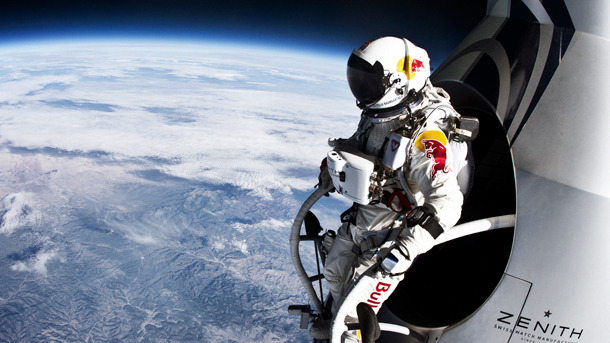
“Red Bull gives you wings.” The Austrian brand’s most famous advertising line was never just a catchphrase. It is, almost literally, a summary of how Red Bull decides where to put its money. On 14 October 2012, Felix Baumgartner let himself fall from 38,969 metres, becoming the first man to break the speed of sound with no engine around him. Red Bull had funded the entire operation — five years of work, on a budget it has never disclosed but that outside estimates place between $30 million and $50 million — with no guarantee it would succeed. A failed jump, or worse, would have been a public-image disaster on a massive scale. We covered the details, including the free-fall duration record that still stands unbroken, in our in-depth piece on Stratos.
That calculated risk was not a one-off. It is the method.
The model: own the asset, don’t just appear on it
Most brands that invest in sport are buying visibility: a logo on a shirt, a banner trackside. Red Bull, in many of its biggest projects, has chosen to own the asset instead of renting a corner of it.
In football, the group directly controls RB Leipzig in Germany, the New York Red Bulls in the United States, FC Red Bull Salzburg in Austria and, in Brazil, both Red Bull Bragantino and Red Bull Brasil — a network of clubs built to move young talent between leagues, with Leipzig as the final stop on that pipeline. In 2025 the group also acquired a minority stake in Leeds United, its first direct foothold in English football.
In motorsport the logic is identical: Red Bull doesn’t sponsor a Formula 1 team, it owns two of them. Oracle Red Bull Racing and its sister team, Racing Bulls, both race under the group’s control, which effectively removes the layer of mediation typical of a standard sponsorship — the same company that makes the drink decides the budget, the commercial strategy and even the activation calendar.
The Junior Team: betting on a driver before he’s famous
Alongside owning teams outright, Red Bull built a scouting and funding programme for young drivers, the Red Bull Junior Team, running for more than twenty years. The return on that investment plays out over decades, not seasons: the programme has produced Sebastian Vettel (four world titles with Red Bull Racing between 2010 and 2013, before retiring from Formula 1 at the end of 2022), Daniel Ricciardo, Max Verstappen — a four-time world champion between 2021 and 2024 — and, more recently, Isack Hadjar, promoted alongside Verstappen for the 2026 season.
It’s the same principle behind the Baumgartner jump, applied to people instead of an event: back potential before the market recognises it and drives the price up.
A lead that’s narrowing, not disappearing
On the product side that funds all of this, though, the picture has shifted over the past decade. In the early 2010s Red Bull dominated the energy drink market with an estimated share of around 70%. Today the picture looks different: Red Bull remains the global market leader, but its share has fallen to roughly 43%, while Monster Energy has grown to around 39% — together, the two brands cover more than 80% of the global market. Red Bull still sells over 12 billion cans a year in nearly every country in the world, but the competition is real now, not theoretical.
That’s not a detail to bury in a sponsorship case study — it’s arguably the reason Red Bull keeps investing so aggressively in sport. A brand that owns the teams fans follow, the athletes kids want to be, and the events that make headlines worldwide doesn’t need to win on the supermarket shelf alone.
The numbers behind the strategy
In 2024 Red Bull generated roughly €11.2 billion in revenue, selling the 12.7 billion cans mentioned above. A large slice of that revenue — an estimated marketing budget of around $3 billion — goes into sports sponsorship, spread across more than 600 athletes worldwide and disciplines ranging from Formula 1 to extreme sports like cliff diving and Flugtag, the event where amateur competitors launch homemade flying machines off a platform above water.
These are figures no traditional sponsor — the kind that buys nothing more than ad space — could justify. But Red Bull isn’t buying space. It’s building a sports ecosystem it owns, generating content from it, and using it to sell cans long after the event itself is over. For brands weighing up an F1 sponsorship today, our guide to F1 sponsorship lays out which other models — far less capital-intensive than Red Bull’s — are realistically within reach.
Frequently asked questions about Red Bull's sponsorship strategy
Why is Red Bull's sponsorship strategy so often cited as a textbook case?
Because Red Bull directly owns many of the assets it’s associated with instead of simply buying visibility, taking on the risk itself rather than paying someone else to carry it.
Which football clubs does Red Bull own?
RB Leipzig, the New York Red Bulls, FC Red Bull Salzburg, Red Bull Bragantino and Red Bull Brasil, plus a minority stake in Leeds United acquired in 2025.
What is Red Bull's energy drink market share today?
Around 43% globally, down from about 70% a decade ago. Monster Energy holds roughly 39%. Red Bull still sells more than 12 billion cans a year.
How much does Red Bull spend on sports sponsorship each year?
Its marketing budget runs to an estimated $3 billion a year, spread across more than 600 athletes.
Which drivers have come out of the Red Bull Junior Team?
Sebastian Vettel (four titles, 2010-2013), Daniel Ricciardo, Max Verstappen (four titles, 2021-2024) and Isack Hadjar, promoted to the senior team for 2026.