

It’s July 2026 in Monaco. Kimi Antonelli crosses the finish line first on a circuit that has historically rewarded patience. Nearly eighty million people worldwide watch that moment. In Italy, though, this summer’s numbers tell a different story from the rest of Europe’s major markets, where the championship’s television audience is declining. Italian audiences for Formula 1 grew by more than 25% in 2026 compared with the previous season. For the Japanese Grand Prix alone, Sky Sports Italia recorded 824,000 viewers – up 36% on the same race in 2025.
This isn’t the reflection of a Ferrari fighting for the title. It’s something rarer: an Italian driver leading the world championship.
Let’s try to put a name to this phenomenon. Call it the Italian window: the moment – cyclical but unpredictable, never guaranteed – in which the presence of a competitive Italian driver transforms the country’s media attention around Formula 1 into something qualitatively different. It isn’t the usual devotion to Ferrari, which is structural and doesn’t depend on where the team sits in the standings. It’s an additional layer of exposure, a cultural salience triggered when the sports headlines aren’t about the Scuderia, but about an Italian winning in someone else’s car.
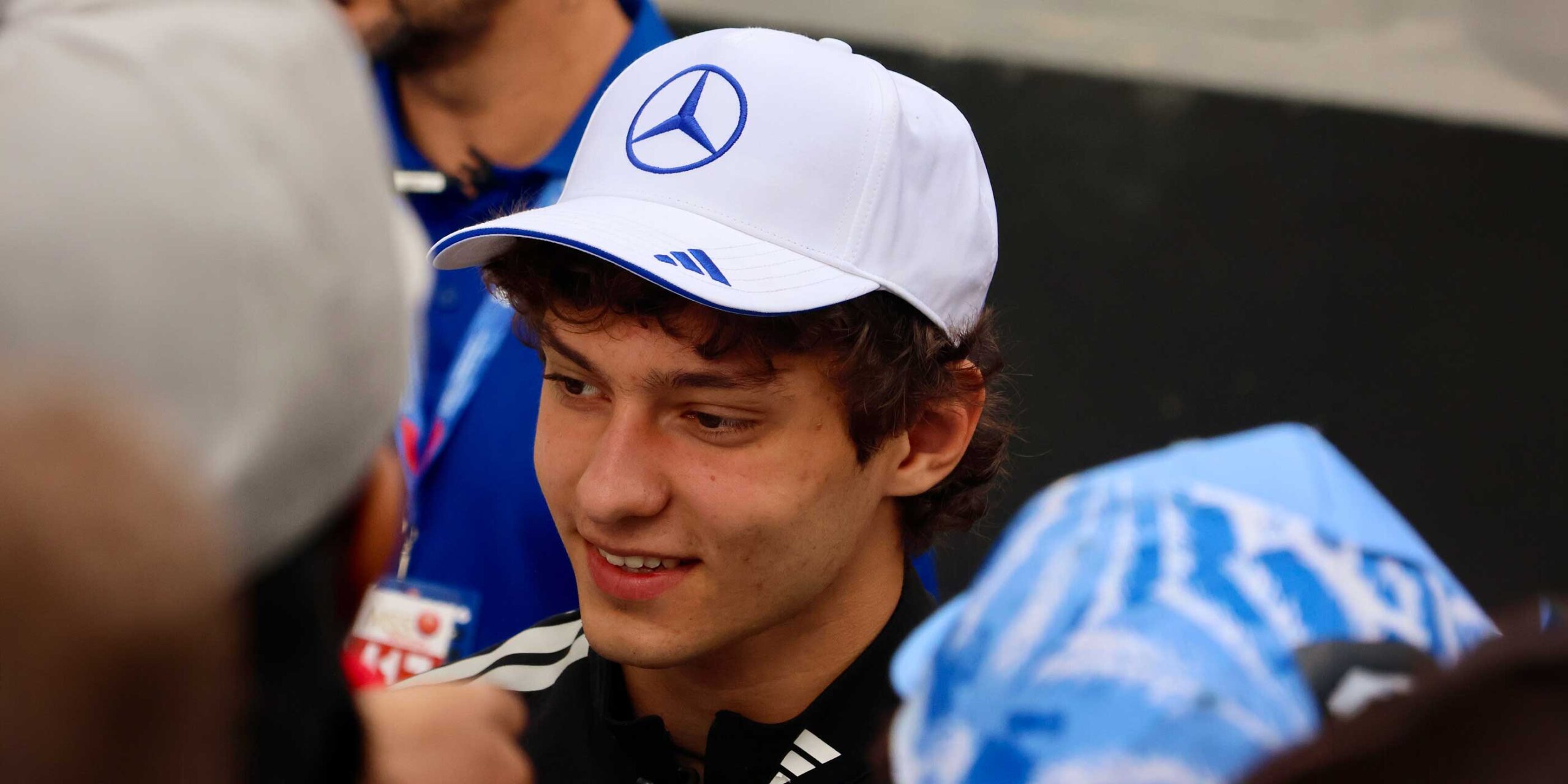
Andrea Kimi Antonelli, Italian, 19 years old, is that open window right now. With 242 points and a 59-point lead over the chasing pack – Lewis Hamilton and George Russell, tied on 183 – after twelve races, he is the first Italian driver with a genuine shot at the world title since Michele Alboreto in 1985. Stefano Domenicali, CEO of Formula 1, has publicly cited the young Italian driver’s impact as one of the factors behind the championship’s record season for attendance and viewership – what the sports press has dubbed the Antonelli effect. When the commercial leadership of a sport names a driver as a growth driver, it isn’t describing a sporting phenomenon. It’s describing a market condition.
Two effects, one window
At least two distinct effects are at work inside this window, and they’re worth separating.
The first is dimensional: Italy’s Formula 1 audience isn’t just growing in volume, it’s changing in composition. A competitive Italian driver brings segments of the audience to the championship that don’t normally follow the races with the same intensity – an audience more diverse in age, more digitally native, more attached to a specific protagonist than to a team. The 135,000 monthly searches for the name “Kimi Antonelli” in the Italian market alone – with the season’s peak still ahead – aren’t generated by a media campaign: they’re generated by a sporting result. It’s the most expensive form of attention to buy, and the cheapest to ride, if you’re already on board.
The second effect is temporal, and this is the point worth focusing on if you’re thinking in terms of sponsorship.
The asymmetric map
The Italian brands present in Formula 1 in 2026 are, in overwhelming majority, Ferrari F1 sponsors: among others, UniCredit, Peroni Nastro Azzurro, Gruppo Sanpellegrino, Sabelt – a portfolio consistent with Ferrari’s identity as a symbol of Italian-ness in the world. It’s a rational, deeply rooted choice. Every euro invested there carries an immediate cultural code.
But this creates an asymmetric map. The driver winning the championship, the driver around whom the Italian window has opened, drives a Mercedes. The current Mercedes F1 sponsorship roster reads PepsiCo, Microsoft, Petronas, Nu: all international, none Italian. There is no Italian brand presence on the livery of the car driven by the only Italian fighting for the World Championship.
This isn’t a judgment on how budgets are currently allocated. It’s an observation about the structure of the opportunity.
The right-moment paradox
There’s a well-known paradox in sponsoring emerging drivers. The moment of lowest visibility – when a young driver signs his first contract with a top team – coincides with the lowest cost of entry and the highest perceived risk. The moment of greatest clarity – an Italian leading the World Championship in a German car – coincides with a window that’s already partly used up. Sponsorship budget approval cycles are long. Contracts have lead times of six, twelve, sometimes eighteen months. Anyone who wanted to be part of this story from the start should have begun evaluating it in 2024, when Antonelli signed with Mercedes, even before his Formula 1 debut.
That said: the window is still open. And in Formula 1, windows don’t reopen as wide the second time.
For Italian brands that have looked at Formula 1 as territory worth exploring without finding the right angle, that map now has a point of entry that hasn’t presented itself with this much clarity in forty years. Brands weighing how to invest in Formula 1 sponsorship have a long history of finding in the sport the multiplier they were looking for and just as long a history of waiting for the perfect moment until they lost it.
This is something sponsors, agencies, and sports properties can no longer afford to ignore. And it’s something that should be put to work today.
Frequently Asked Questions
Andrea Kimi Antonelli is an Italian Formula 1 driver, born in 2006. After dominating Formula 2 in 2024, he made his Formula 1 debut in 2025 as George Russell’s teammate at Mercedes, finishing seventh in the World Championship with 150 points – the highest total ever scored by a rookie under the current points system. In 2026, in his second season, he leads the World Championship with 242 points after twelve races and six wins.
Antonelli is the first Italian driver with a genuine chance of winning the World Championship since Michele Alboreto’s 1985 season. His rise has generated what’s now called the Antonelli effect: Italy’s television audience for the championship grew by more than 25% in 2026 compared with 2025, with peaks of 36% on individual races. An Italian driver fighting for the title brings organic media attention in the Italian market that no equivalent campaign can replicate for the same budget.
Sponsoring a driver can take the form of a personal deal – logo on the race suit and helmet, content and communication activity – or an agreement with the team, with visibility on the car and in team activities. Contracts typically include image rights, activation rights, hospitality and digital rights. F1 sponsorship costs vary depending on the driver’s tier, the team, and the rights included, and negotiation cycles require starting the evaluation well ahead of the target season.
The main Italian brands active in Formula 1 in 2026 are concentrated on Scuderia Ferrari: among others, UniCredit, Peroni Nastro Azzurro, Gruppo Sanpellegrino and Sabelt. Italian presence on other teams – including Mercedes, the team of championship leader Antonelli – is instead limited, which creates a positioning opportunity for brands wanting to associate with the Italian driver currently leading the standings.
The starting point is assessing the alignment between Formula 1’s audience – global, with a strong B2B component in hospitality and licensing programs – and the brand’s profile. RTR Sports works with brands across different sectors to structure Formula 1 sponsorships consistent with their marketing objectives and available budgets.