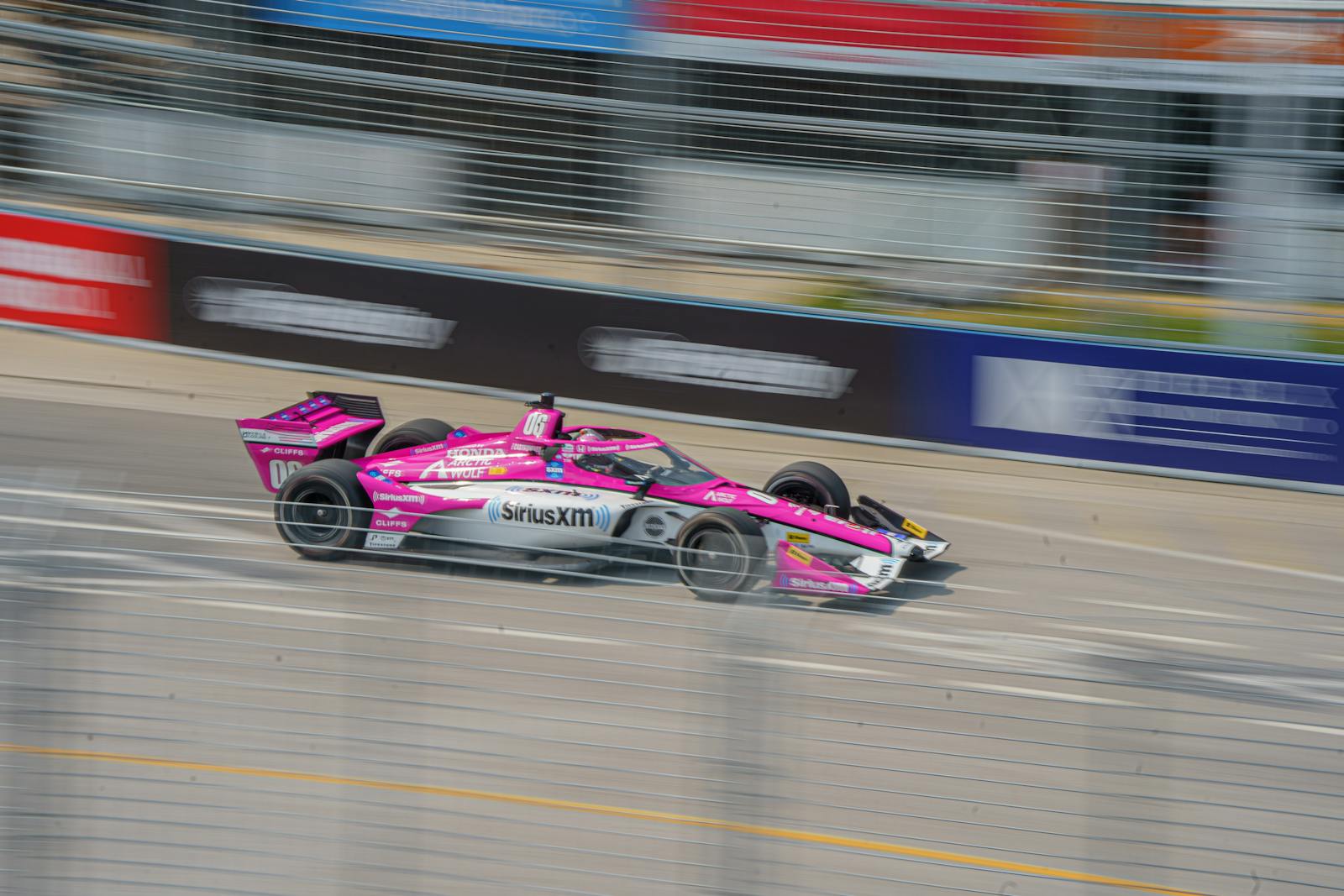
Push to Pass is a button on the steering wheel of an IndyCar that, for a few seconds, raises the turbo boost and gives the engine roughly 60 extra horsepower. The driver can use it whenever they like under green-flag conditions, apart from a few exceptions set by the rulebook, but the reserve of time is limited: between 150 and 200 seconds per race, depending on the circuit, with a maximum of 15 or 20 seconds per push. It is used only on road and street courses, never on ovals.
Put like that it sounds like a technical matter, and partly it is. But Push to Pass is above all a matter of strategy, and for a few years now of regulation too: twice, in 2024 and in 2026, the whole series was set talking by a piece of software that did not switch off when it should have.
How Push to Pass works
The system is managed by the engine control unit. When the driver presses the button, the 2.2-litre twin-turbo V6 gets more boost for as long as the button stays active, up to the limit of a single push. Every second of use is deducted from the reserve available for the race.
The limits change from track to track. In 2025, for example, at St. Petersburg, Thermal, Detroit and Laguna Seca drivers had 150 seconds in total and at most 15 per push; at Long Beach, Barber, the Indianapolis road course, Road America, Mid-Ohio, Toronto and Portland 200 seconds and at most 20. In 2026 St. Petersburg stayed at 150 seconds, while the new Arlington race and the Indianapolis road course have 200; the May rule review did not touch the timings.
On ovals there is no Push to Pass: it is a tool designed for road and street courses, where braking zones and corner exits provide the overtaking opportunities.
Attack, defence and fast laps
The name says “push to pass”, but real-world use is subtler. Push to Pass is used to attack on corner exit and on the straight, of course, but also to defend against whoever is coming from behind, because the car in front has its button too. And it is used to set a fast lap at the right moment, before or after a pit stop, when a few tenths can be worth a position.
The point is that the seconds are few and the race is long. Whoever wastes them early risks reaching the finale with no reserve, just when the duel is being decided. That is why managing Push to Pass has become as much a part of strategy as tyres and fuel, and the countdown of seconds is one of the numbers teams follow from the pit wall.
Push to Pass and the hybrid
Since July 2024 IndyCars have also had a hybrid system, which recovers energy mainly under braking and gives it back under acceleration: roughly 60 more horsepower, which the driver can also manage with dedicated controls on the steering wheel. Added to Push to Pass, the hybrid takes total power beyond 800 horsepower on road and street courses, a threshold the series had not seen for around twenty years.
The two remain separate, though. Push to Pass raises the turbo boost for a set amount of time; the hybrid uses recovered energy, with a per-lap deployment limit that changes from track to track. For the driver that means two reserves to manage, with different rules. The hybrid also has a cost in terms of weight, as we explained when looking at how much an IndyCar weighs.
St. Petersburg 2024 and Long Beach 2026: when the software gets it wrong
On 10 March 2024 Josef Newgarden won the season opener at St. Petersburg. Six weeks later, on 24 April, IndyCar took the win away from him: on the Penske cars the software used in the hybrid testing had not been removed, leaving Push to Pass usable on restarts when the rulebook prohibited it, and Newgarden had used it. His team-mate Scott McLaughlin, third at the finish, was disqualified too; Will Power, fourth, lost ten points. The win went to Pato O’Ward. The three Penske cars were fined $25,000 and lost the race prize money.
Two years later the problem came back, but the other way round. On 19 April 2026, at Long Beach, a fault in the series’ own software made it impossible to disable Push to Pass during the full-course yellow and the restart that followed on lap 61: twelve drivers used it on lap 62, when it should not have been available. This time the responsibility was IndyCar’s, and the results stood. From the Indianapolis road course Grand Prix on 9 May, the series rewrote the rules: after the start, once the car has passed the alternate start-finish line, Push to Pass can be used at any time under green-flag conditions, and therefore on restarts too, and it is up to the teams to make sure it is not used when it is prohibited.
Where Push to Pass comes from
The idea was not born in IndyCar. In 2004 Champ Car and Cosworth introduced a similar button on the series’ turbo V8s: around 50 extra horsepower, for a total of 60 seconds per race. The Indy Racing League, from which today’s IndyCar descends, approved it on 28 July 2009 and gave it its debut on 1 August on the Kentucky oval: 20 horsepower for 12 seconds, usable at most 20 times. Since then the system has been revised several times, up to today’s set-up.
Formula 1, too, has had a driver-controlled overtaking aid since 2026: Overtake Mode, which gives extra electrical energy to a chasing car within one second and has taken over the legacy of DRS, replaced by active aerodynamics. Two different philosophies for the same problem, which you will find compared in our article on IndyCar and Formula 1. For anyone looking at these championships as a sponsor, the starting points are our guide to IndyCar sponsorship and our page on how to sponsor in Formula 1.
Frequently asked questions about Push to Pass in IndyCar
What is Push to Pass in IndyCar?
It is a system managed by the engine control unit that, when the driver presses a button on the steering wheel, raises the turbo boost and gives the engine roughly 60 extra horsepower for a limited time. It is used to attack, to defend and to set fast laps, and only on road and street courses.
How many seconds of Push to Pass does an IndyCar driver have?
It depends on the circuit. In 2025 drivers had 150 seconds in total, with at most 15 per push, at St. Petersburg, Thermal, Detroit and Laguna Seca, and 200 seconds, with at most 20, on the other road and street courses. In 2026 St. Petersburg stayed at 150 seconds, Arlington and the Indianapolis road course are at 200, and the May review did not change the timings.
Is Push to Pass used on ovals?
No. Push to Pass is only available on road and street courses. On ovals, including the Indianapolis 500, it is not enabled.
What is the difference between Push to Pass and the hybrid?
Push to Pass raises the turbo boost for a limited number of seconds per race. The hybrid, in use since July 2024, recovers energy mainly under braking and gives it back under acceleration, adding roughly 60 horsepower. Together they take power beyond 800 horsepower on road and street courses.
Why did Newgarden lose his St. Petersburg 2024 win?
Because the software from the hybrid testing had been left on the Team Penske cars, leaving Push to Pass usable on restarts when the rulebook prohibited it. On 24 April 2024 IndyCar disqualified Josef Newgarden, the winner, and Scott McLaughlin, third; Will Power lost ten points. The win went to Pato O’Ward and the three cars were fined $25,000.
What changed in 2026?
After the series’ software malfunction at Long Beach on 19 April 2026, IndyCar rewrote the rules: after the start, once the car has passed the alternate start-finish line, Push to Pass can be used at any time under green-flag conditions, restarts included, and the responsibility for not using it when it is prohibited lies with the teams. The time available, both in total and per push, stayed the same.