

The Three Phases of the Lenovo-Ducati Deal
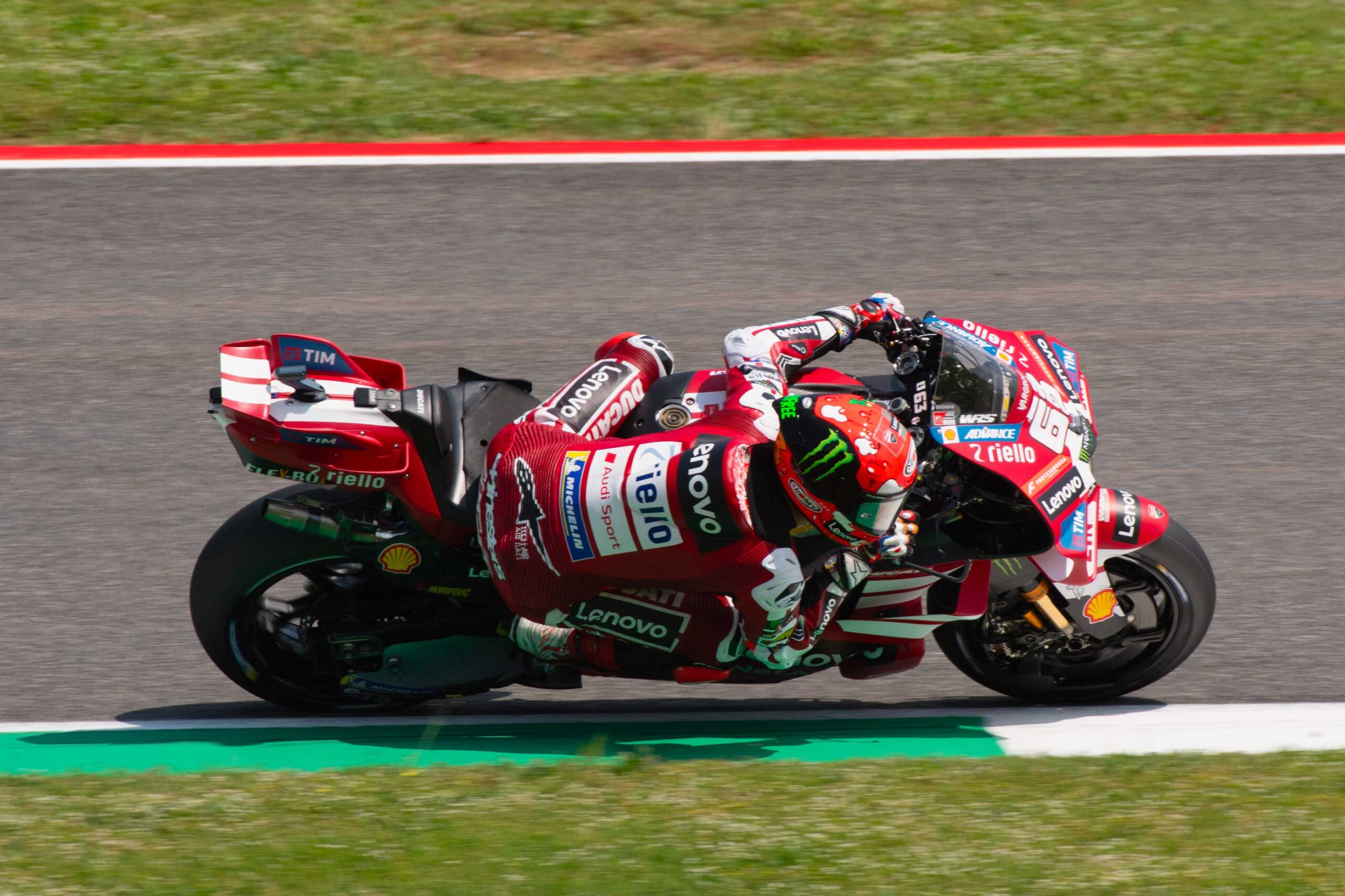
Phase 1 – 2018: technology partner. Lenovo has signed a multi-year sponsorship agreement with Ducati Corse for MotoGP. The team’s branding remains unchanged. What’s changing is the behind-the-scenes technology infrastructure: the team is switching to Lenovo PCs, tablets, and servers, both at the track and at the factory. This isn’t just a livery change. It’s a technology stack migration, with the team receiving enterprise-grade hardware and Lenovo, in return, gaining access to a data-intensive operating environment in which to demonstrate the reliability of its products. It’s the infrastructure layer. Phase 2 – 2020: co-branded product. The Lenovo Ducati 5, a limited-edition crossover laptop featuring Ducati Corse design elements, is now on the market. It is the first public indication that the partnership has resulted in genuine product integration, not just a branding collaboration. For the CMO, this is a major asset: the deal can produce co-branded products that the sales division can actually sell. For the CIO, it confirms that the operational relationship is mature enough to support product-level development. Phase 3 – February 2021: title partner. Lenovo signs on as Title Partner of the Ducati MotoGP Team. The team’s official name becomes the Ducati Lenovo Team. It is a three-year deal, which was subsequently extended, and as of June 2026, it is still in effect: the team has just confirmed Marc Marquez for 2027 and 2028, and the entire MotoGP grid signed the 2027–2031 five-year stability framework in Brno. For a commercial and form-based breakdown of Márquez and the rest of the 2026 grid — including their sponsorship value profiles — see RTR’s guide to the best motogp rider rankings for 2026. The Lenovo partnership now exists within an industrial context of contractual stability that did not exist eight years ago. In July 2026, ahead of World Ducati Week, Lenovo deepened the partnership further, becoming Title Partner of the Lenovo V2 Future Champ Academy – Garage 51 | Ducati, the team’s young-rider development programme — evidence the collaboration keeps expanding, not just holding steady. Three phases, eight seasons, a linear progression: infrastructure, product, naming. It is a reconstructible framework, not a one-time event. And reconstructible means replicable.What the deal does that the price doesn’t show
The part of the briefing that’s hardest to incorporate into sales slides is the section on what the deal includes beyond the livery. For a CFO or an investor relations professional, this is the section that’s hardest to quantify. For the CIO or whoever actually makes the decision, it’s the decisive section. In the Lenovo-Ducati partnership , the deal includes enterprise hardware integrated into the team’s operations: PCs, servers, and edge devices at the track, as well as data analytics and artificial intelligence/machine learning workloads related to the race cycle and setup simulation. The team uses this technology every day. Lenovo uses the team as a continuous stress-testing environment for a workload that requires uptime, low latency, and the management of distributed assets. For a CIO evaluating an enterprise hardware vendor, seeing Lenovo operate in a MotoGP environment—where real-time constraints, geographic mobility, and safety-critical data are involved—serves as proof of capability that no written case study can replicate. The same package in F1 today costs significantly more, and the reason isn’t the quality of the championship. It’s the maturity of the market. F1 has already gone through the Liberty 2017–2024 rerating—the analysis I presented in my previous article“Liberty Media’s MotoGP Roadmap for 2026,”and tech partnerships with title sponsors such as Microsoft-Mercedes (now reported at roughly $60M/year) or Oracle-Red Bull ($110M/year) reflect post-revaluation assets. MotoGP, on the other hand, is in the midst of its own revaluation, with the pricing window currently open and evolving following the recent signing of the stability pact governing the years 2027–2031.Pitfalls to avoid… especially if you work in the tech industry.
The mistake that CIOs and tech CMOs evaluating motorsport sponsorship must avoid is viewing the deal solely as brand exposure. This is the metric that many sponsorship agencies continue to tout as their headline: media value, brand reach, audience impressions —because it’s the easiest to measure using standard tools. It’s also the metric that applies equally across all championships and says almost nothing about the specific fit between a B2B tech brand and a particular motorsport asset. For a benchmarked view of how the championship’s biggest motogp sponsors have structured their deals — from Red Bull to Castrol to Michelin — see RTR’s guide to the most famous brands in MotoGP sponsorship. In a previous article – MotoGP vs. F1 Sponsorship: What the Gap Actually Buys —I argue that the real gap between the two championships isn’t the price of title sponsorship—that’s easy to see—but rather what the various partnerships include in terms of operational integration, B2B commercial assets, and access to the teams’ supply chains. The Lenovo case is a practical application of that reasoning. The Lenovo-Ducati deal is not simply a title sponsorship supplemented by a case study. It is an infrastructure migration, a product co-development program, and a title sponsorship. These three layers are not optional. They are components of a single architecture. The other mistake is to think of B2B motorsport as simply “buying the car.” The point of the Lenovo partnership isn’t the branding on the Desmosedici—even though that’s there and it works. It’s that the software is running in a production environment, within an organization that races to win. For the CIO, it’s the difference between seeing a demo at a keynote and seeing the software manage a real-world environment.How We at RTR Talk About It—The Three Layers of Tech Integration in Motorsports
For the CIO or CMO of a B2B tech company considering a motorsports sponsorship program over the next 12–18 months, Lenovo’s three layers serve as the operational foundation. Layer 1: Infrastructure. The vendor’s enterprise hardware becomes the team’s infrastructure. This isn’t just marketing hype—it’s a migration. Discussions take place with the team’s CTO, not the marketing director. This is the layer where the vendor’s product is put under real-world stress, and where the team gains genuine technological capabilities—not just sponsorship money with a sticker on it. This is the level Lenovo entered in 2018, and it’s what distinguishes a tech deal from a logo-placement deal. Pricing tier: the lowest of the three, but the one that takes the longest to build. Layer 2: Product co-development. The deal results in a co-branded product that the sales division can actually sell. The Lenovo Ducati 5 in 2020 is an example of this. This is the layer where the vendor’s sales team begins to see a measurable ROI in terms of the product itself, not just the brand. For the CMO, this is the most visible layer internally: it’s what justifies investments—even at the commercial level—to the CFO without having to rely solely on media value reports. Pricing tier: incremental compared to Layer 1, but with direct commercial ROI. Layer 3: Title naming. The team’s full branding— Ducati Lenovo Team —is the final step, not the first. It amplifies awareness of a partnership that is already a reality at the operational and product levels. When this layer is in place on top of an integration that’s already functioning, the price of title sponsorship is justified as a value multiplier, not as a pure visibility expense. Pricing tier: the highest, but the least difficult to approve when the two underlying layers are already delivering results. The three layers are not alternatives; they are progressive. It is possible to start directly at Layer 3 (which is what most large companies tend to request, both in MotoGP and F1), but the ROI of a pure Layer 3 solution is a fraction of the ROI of the three layers combined. What Lenovo has built is the most well-documented example of a complete stack on the market.The concise question
For anyone considering a sponsorship in motorsports today, the question isn’t “MotoGP or F1.” It is: at what level are we ready to enter, and over what time frame? If the time horizon is twelve months and the goal is brand awareness in an established market, F1 at current prices remains a legitimate but costly choice. If the time horizon is thirty-six to sixty months and the goal includes operational integration, product co-development, and competitive positioning before the MotoGP rerating is complete, the MotoGP window is the same one Lenovo seized in 2018, applied today to the championship where Liberty is charting the roadmap. Buying a B2B motorsport tech solution in 2026 isn’t like buying a TV commercial. It’s like buying software that runs in production, not a demo for a keynote presentation. What you’re paying for is the fact that it works every day, not the fact that you see it once a week. Integration comes before the logo. Always.Frequently Asked Questions
The exact value has never been disclosed by either Lenovo or Ducati. Industry press estimates put MotoGP factory-team title sponsorship pricing at $3–8 million a year for mid-tier teams and $7–10 million a year for a top team like Ducati — a fraction of the $110 million a year Oracle pays Red Bull Racing for its F1 title sponsorship.
Since 2018, when Lenovo became Ducati Corse's technology partner, supplying enterprise hardware (PCs, tablets, servers) both trackside and at the factory. In 2020 the partnership produced the co-branded Lenovo Ducati 5 laptop, and since February 2021 Lenovo has been Title Partner: the team races as the Ducati Lenovo Team.
Yes. The three-year deal signed in 2021 was extended and remains in force: the team has confirmed Marc Marquez for 2027 and 2028, and in June 2026 the entire MotoGP grid signed the 2027–2031 stability agreement with Liberty Media in Brno. In July 2026 Lenovo further expanded the partnership, becoming title partner of the Lenovo V2 Future Champ Academy – Garage 51 | Ducati, the team's young-rider development programme.
Oracle pays Red Bull Racing around $110 million a year for F1 title sponsorship, while Microsoft signed a deal worth roughly $60 million a year with Mercedes-AMG Petronas in January 2026. The Lenovo-Ducati deal costs a fraction of both, but includes the same three integration layers — infrastructure, product, naming — at a lower pricing tier, because MotoGP's commercial rerating, unlike F1's (2017–2024 under Liberty Media), is still under way.
Three progressive layers: infrastructure (enterprise hardware, data analytics and AI/ML workloads integrated into the team's daily operations), product co-development (like the 2020 Lenovo Ducati 5 laptop), and title naming. Naming is the last step, not the first: it amplifies an integration that is already real at the operational level, rather than replacing it.