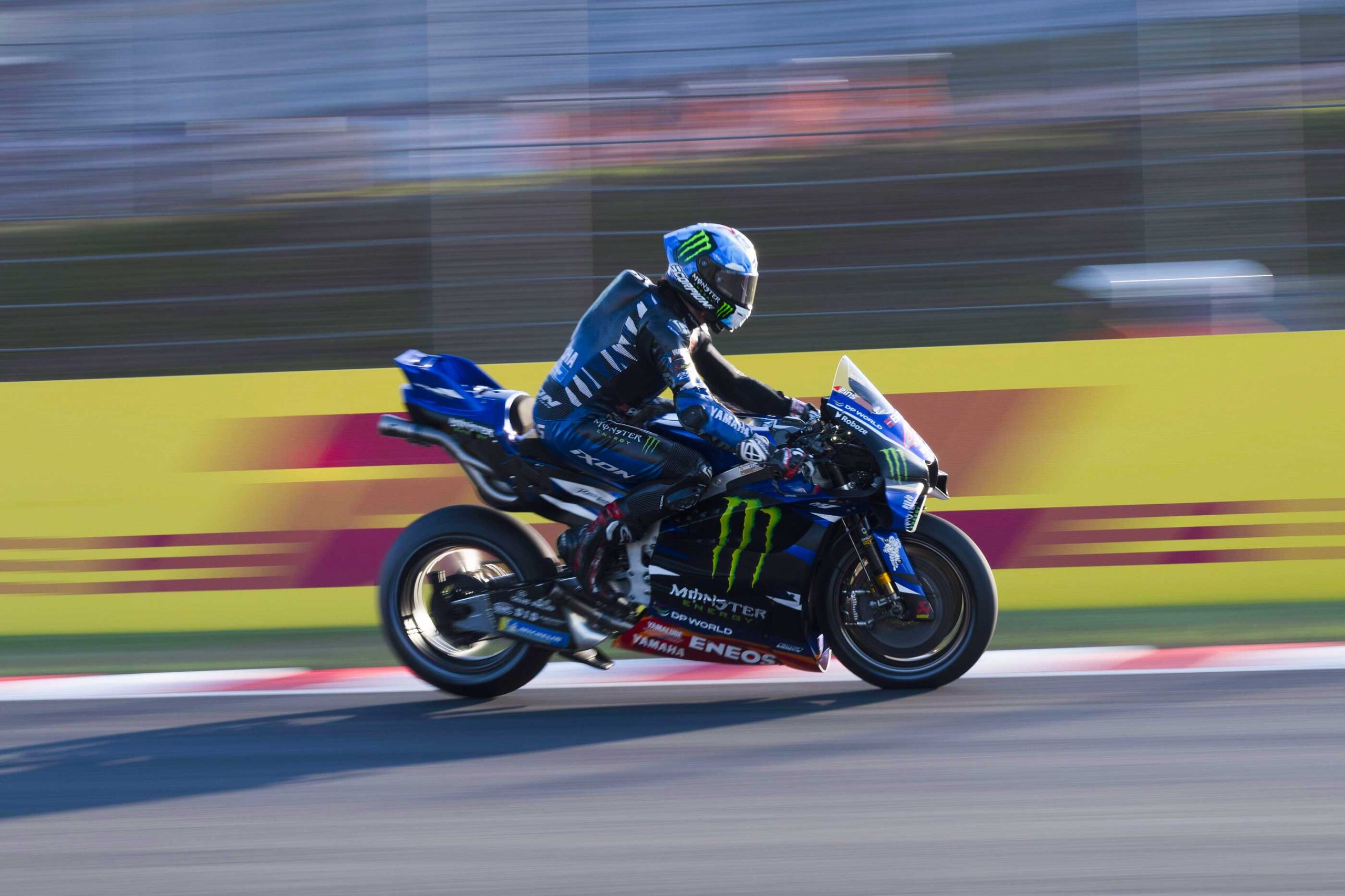
MotoGP riders stick their leg out under braking for three reasons: to lower and shift their centre of gravity forward, making the bike more stable in the braking zone; to add a little aerodynamic drag; and to close the door on anyone trying to pass on the inside. The technique was born almost by accident in 2005, with Valentino Rossi, and today virtually the whole grid uses it.
Updated September 2026.
Anyone who follows MotoGP knows that riding styles change along with the bikes. The torso tucked behind the fairing, the knee on the ground, then the elbow, and finally the leg coming off the footpeg in the last metres of braking. Each of these gestures was born from an obsessive search for hundredths of a second, and each of them has also become, over time, an image: the one fans recognise instantly and the one TV cameras hunt for in every braking zone.
Why Do MotoGP Riders Dangle Their Leg? The Short Answer
The leg dangle is mainly about making the bike more stable when the rider brakes at the limit. Shifting a substantial part of their body weight inwards and downwards helps keep the bike composed while the braking force pushes everything forward. On top of that there is a small parachute effect and a tactical advantage: the leg occupies the space on the inside and discourages anyone who wants to dive through. None of the three effects explains everything on its own, and it is their combination that has made the gesture so widespread.
Valentino Rossi and the Origin of the Technique
The leg dangle as we know it is traced back to Valentino Rossi. On 10 April 2005, at the Spanish Grand Prix at Jerez, at the final corner of the last lap, Rossi threw his bike up the inside of Sete Gibernau, then riding for the Movistar Honda team. The braking was on the limit, contact was inevitable, and in that moment Rossi instinctively took his inside leg off the footpeg and left it hanging until the apex. He made the pass, won the race and ended that season as world champion.
From then on the gesture spread quickly, first among riders who imitated it and then among those who studied its effects, calibrating how far to open the leg and when to pull it back in. Today it is hard to find a MotoGP rider who does not use it, more pronounced in the heaviest braking zones or barely hinted at in slower changes of direction. One of the few famous exceptions was Jorge Lorenzo, a three-time premier-class champion, who used it rarely and was still extremely fast through the corners.
1. Braking Stability: A Lower Centre of Gravity
The reason riders cite most often is stability. The forces in a MotoGP braking zone are enormous: at the first corner of Mugello, according to Brembo data, the bikes go from 337 to 94 km/h in 5.4 seconds and 291 metres, with a load of 5.5 kilos on the brake lever. In that phase the weight transfers onto the front and the bike tends to move around.
A leg accounts for about 16-18% of an adult’s body mass, roughly ten kilos for a rider of average build. Moving it away from the body, inwards and downwards, shifts the centre of gravity of the bike-and-rider package and helps keep the bike more composed as the rider sets up the corner. Sylvain Guintoli, 2014 Superbike world champion, put it this way: dangling the inside leg lowers the centre of gravity, and that increases braking stability and performance. There is also a less visible effect: the braking position is tiring, and freeing a leg for a moment relieves the load on muscles and arms.
2. The Air Brake: The Parachute Effect
The second reason is aerodynamic. At those speeds, a leg sticking out of the bike’s silhouette exposes more surface to the airflow and works like a small parachute, the same principle as dragsters opening their chute at the end of the strip or aircraft extending their flaps on landing. The contribution is modest compared with the brakes, but in a braking zone that scrubs off more than 200 km/h in a few seconds every metre counts. The old rule of motorcycle racing still applies: first on the throttle, last on the brakes.
The air resistance on the leg also tends to rotate the pelvis and torso slightly, and this small rotational moment helps the rider turn the bike into the corner.
3. Tactical Defence Against Overtaking
The third reason is the most pragmatic. In today’s MotoGP, with 22 riders on the grid and tiny gaps between them, braking zones are where most overtakes happen, and the inside of the corner is the door riders try to get through. The open leg occupies that space, makes the attack harder and sends the rival a clear message. It is a shield that is as psychological as it is physical.
Myth, Science or Placebo?
Establishing which of the three effects matters most is difficult, and the riders themselves give different answers. Cal Crutchlow has explained that it is easier to put the leg out in left-hand corners and that, as a rule, shorter riders open it more; in his view, dangling the leg is faster. Rossi himself, asked why he did it, always answered more or less the same way: it simply felt right.
One fact remains: if almost all of the fastest riders in the world have adopted this technique, there is an advantage, even if only a psychological one. And like the knee on the ground before it, the leg dangle has become more than a technical gesture: it is one of MotoGP’s visual symbols, one of those images that make the fortune of photographers, TV directors and, by extension, the brands on the leathers, boots and fairings.
Why This Gesture Matters to Brands
For anyone investing in motorsport, moments like this are the heart of the value. The braking zone is among the most filmed points of a Grand Prix: close-ups, shots from the outside of the corner, slow-motion replays. That is where the bike, the rider and the logos they carry stay on screen longest. Understanding where the audience’s eyes focus is the first step in deciding where to place a brand, as we explain in our guide to how MotoGP sponsorship works.
If you want to see a MotoGP braking zone live, you will find the races in the 2026 MotoGP calendar; to experience it from the inside, with paddock access, there are the RTR Sports MotoGP hospitality packages. And if you are curious about the riders who changed the way motorcycles are ridden, you will find them in our ranking of the 10 best MotoGP riders of all time.
RTR Sports Marketing has been building sponsorships in Grand Prix motorcycle racing since 1995.
Sources: MotoGP.com, why riders dangle their leg; Brembo, Mugello 2026 braking data; 2005 Spanish Grand Prix; PMC, body segment parameters.
Frequently asked questions
Why do MotoGP riders stick their leg out under braking?
For three reasons: to lower and shift the centre of gravity, making the bike more stable in the braking zone; to create a small parachute effect that helps slow down; and to occupy the space on the inside of the corner and discourage overtakes. None of the three explains everything on its own, and it is their combination that has made the technique so widespread.
Who invented the leg dangle in MotoGP?
The technique is traced back to Valentino Rossi, who at the Spanish Grand Prix on 10 April 2005, at Jerez, instinctively took his leg off the footpeg while passing Sete Gibernau at the final corner. Since then the gesture has been adopted by almost every MotoGP rider.
Does the leg dangle really help braking?
The aerodynamic effect is modest compared with the brakes, but in a MotoGP braking zone, where bikes lose more than 200 km/h in a few seconds, even a small contribution counts. The main benefit riders point to is stability: the bike stays more composed as the rider sets up the corner.
Why do riders dangle their leg mostly in left-hand corners?
Many riders, including Cal Crutchlow, say that opening the leg feels more natural in left-hand corners, partly because of how the rider is positioned on the bike under braking. Every rider has their own style, though: some use it in almost every braking zone, while others, like Jorge Lorenzo, used it rarely.
Do all MotoGP riders use this technique?
Almost all of them, with varying intensity: pronounced in the heaviest braking zones, barely hinted at in slower changes of direction. Among the famous exceptions is Jorge Lorenzo, who used it little and was still one of the fastest riders through the corners.