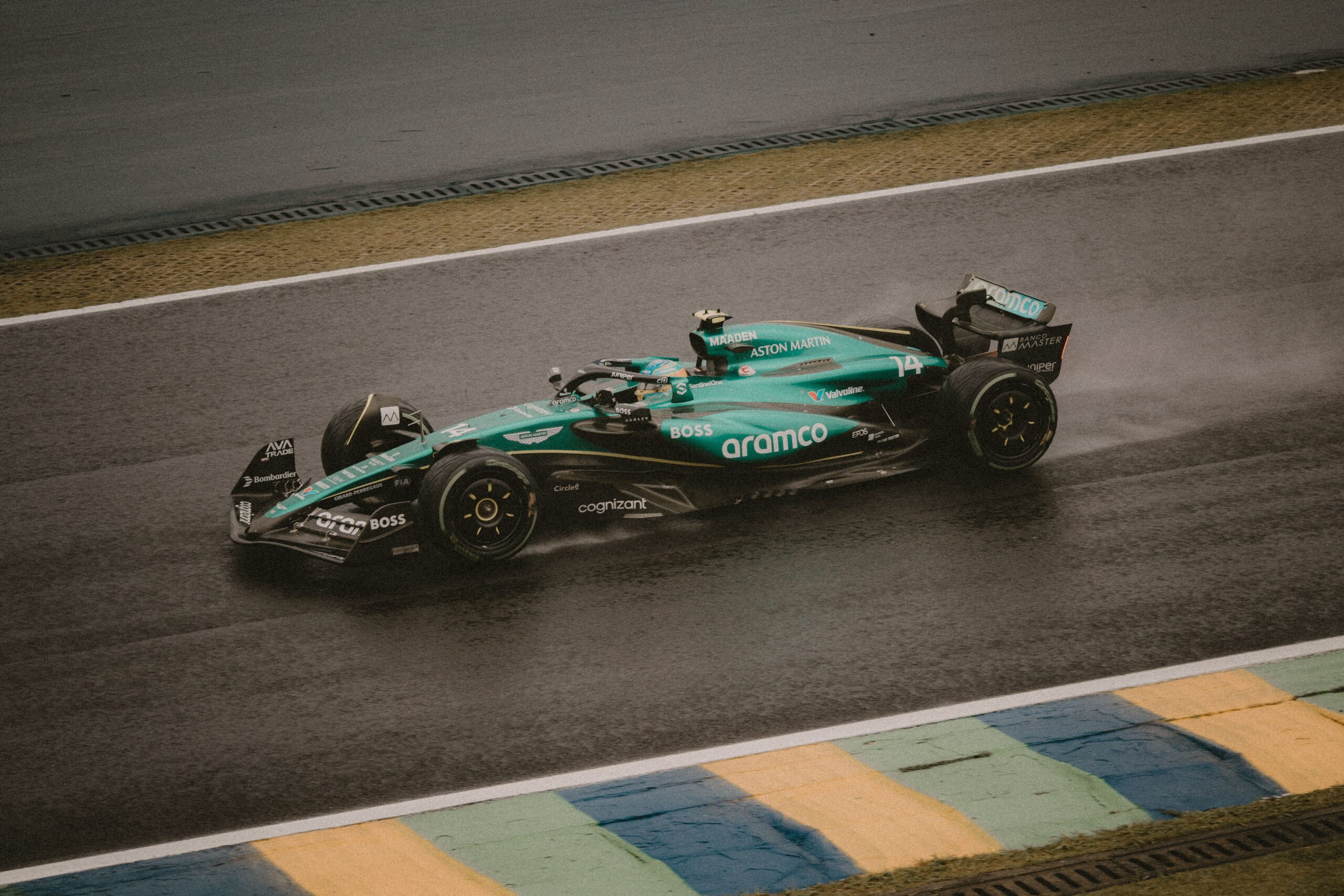


Aston Martin F1 sponsorship in 2026 is the most nuanced commercial evaluation on the grid. This is the only team whose title partner (Aramco) holds a contractual option over 10% of the team’s shares, the only one with Adrian Newey as its managing technical partner and lead car designer, and one of just two teams racing as a Honda works outfit. It is also a team midway through one of the largest structural rebuilds in recent Formula 1 history – new Silverstone campus, new power unit, new technical direction. That combination makes buying into Aston Martin a different decision from buying into McLaren or Red Bull.
Here is what a brand evaluating the platform needs to know first:
- Cost: entry runs from roughly $500K for technical/supplier deals to a title tier estimated in the $75–95M range – all directional, since the team does not publish rate cards.
- Structure: a handful of very large anchor deals (Aramco, Honda, Ma’aden, Cognizant) rather than McLaren’s breadth of 50-plus partners.
- Identity: a Saudi–British commercial axis and the highest concentration of AI and enterprise-tech partners of any team on the grid.
- Context: a difficult 2026 on track, offset by a medium-term trajectory built on Newey, the new campus and Honda’s upgrade pipeline.
This guide covers the cost tiers, the confirmed 2026 partners and what each one gets, the honest upside-and-risk case, and how Aston Martin compares to peer teams. For the cross-team picture, see our pillar on F1 sponsorship costs across all teams; this piece is team-specific.
Aston Martin F1 Sponsorship Tiers: What Each Level Costs
Aston Martin’s commercial structure in 2026 is anchored by a small number of very large deals rather than the wide partner base you find at McLaren. Aramco, Honda, Ma’aden and Cognizant sit at the top and effectively define the team’s identity; new entrants join below those anchor relationships, on the car’s secondary surfaces or as technical and category partners. That concentration matters for anyone weighing the Aston Martin F1 sponsorship cost against rival platforms: there are fewer, larger slots, and the marquee categories are already spoken for. The practical consequence is that the Aston Martin F1 sponsorship cost a brand actually pays depends far more on which tier still has room than on a published rate, because the negotiable inventory sits underneath the anchor deals rather than alongside them.
The table below sets out the tiers and their assets. Every figure is directional – drawn from public estimates at f1salaries.com and RacingNews365, not from officially confirmed values, since neither the team nor its partners disclose deal sizes.
| Tier | Estimated Annual Cost | Key Assets | Named 2026 Example |
|---|---|---|---|
| Title Partner | $75–95M (directional) | Team name, full livery, equity option, deep technical integration | Aramco |
| Works Partner | $20–30M (directional) | Power unit supply, operational co-development | Honda |
| Principal / Major | $15–25M (directional) | Primary car surfaces, hospitality, category exclusivity | Ma’aden |
| Official Technology | $10–18M (directional) | Car placement, operational tech integration, co-branded content | Cognizant, NetApp |
| Associate / Official | $3–10M (directional) | Secondary car surfaces, IP rights, hospitality | Hugo Boss, JCB, TikTok, CoreWeave |
| Technical / Supplier | from $500K (directional) | Engineering integration, product supply | Valvoline, Puma, Pirelli |
What Makes the Aramco Deal Structurally Unique – and Why It Matters for New Partners
Two features of the Aramco title deal are not replicated by any other title relationship on the grid. The first is equity optionality. Filings for AMR GP Limited, the team’s operating company, record that Aramco holds a contractual option to subscribe to 10% of the company’s ordinary share capital – a detail first surfaced by The Race. That blurs the line between sponsor and investor, and it sets a precedent: this is a team that has shown it will put equity on the table as part of a high-value deal. It has since done the reverse too, taking an equity stake in a commercial partner rather than only offering one.
The second is dual presence. Aramco is simultaneously Aston Martin’s title partner and one of Formula 1’s own Global Partners at series level. For a new entrant, that dual relationship means the energy category is effectively ring-fenced at both the team and the championship – essential context for any brand in adjacent energy, fuels or sustainability sectors before it approaches. We cover the full Aramco–Aston Martin partnership in depth in a dedicated case study.
Aston Martin F1 Sponsors and Partners 2026
The Aston Martin F1 partners roster in 2026 is where the team’s commercial character becomes legible. It is not a long tail of small logos; it is a set of deliberate, category-defining relationships. Below we work through them by tier, then summarise the headline partners in a table.
- Title. Aramco has been the team’s title partner since January 2024 on a five-year deal that runs through 2028; the team competes as the Aston Martin Aramco Formula One Team. For 2026, Aramco’s role is technical as well as commercial – its fuel and lubricant work sits alongside Honda and Valvoline as the sport moves to 100% sustainable fuel, and its brand travels across all 24 grands prix, including the title race in Jeddah. The 10% equity option and the dual series-level relationship, covered above, make it the most structurally distinctive title deal on the grid.
- Works power unit. Honda becomes Aston Martin’s works engine partner from 2026, supplying the RA626H power unit – the team’s first works era after years as a Mercedes customer. Adrian Newey’s first Aston Martin car runs Honda power, and Honda branding sits on the power-unit-related positions. Honest context belongs here: the RA626H has struggled for both reliability and outright performance in 2026, and Honda has drawn on the FIA’s development-concession framework to close the gap. That is a live situation, not a permanent verdict – but a partner buying in today should understand it.
- Principal. Ma’aden, Saudi Arabia’s state mining and metals company, has been elevated to the team’s first-ever Principal Partner, deepening the Saudi–British commercial axis that runs alongside Aramco.
- Official technology. Cognizant has partnered with the team since its 2021 return, originally as title partner and now in a technology-services role – a “phase two” of AI, cloud and data integration in which the company frames Formula 1 as a testbed where outcomes are measured in milliseconds. NetApp supplies intelligent data infrastructure, handling the track-to-factory data flow that modern car development depends on.
- Associate and official partners. This is the broadest tier and the most revealing. Long-standing names include Hugo Boss (apparel, with driver-suit visibility) and JCB (British engineering). Digital and consumer brands include TikTok, Coinbase, Pepperstone, Breitling, Oakley, Elemis and Eight Sleep. The enterprise and AI cluster is unusually dense: CoreWeave (AI cloud computing, whose deal also gave its name to the team’s new wind tunnel, estimated at roughly $4–8M a year), Cohere (language models), Arm (semiconductors), Xerox, UKG (workforce technology), Circle and Atlas Air. Two deals stand out for their structure. Cognition, the AI-coding-agent company, joined as a Global Partner on a multi-year basis announced in February 2026 – the team says it “uses the power of AI to perform software development tasks autonomously.” And Public, the US investing platform, is the deal in which Aston Martin took an equity stake in its own partner, reported in April 2025 – the mirror image of the Aramco structure.
- Technical and supplier. Valvoline Global Operations supplies lubricants, working alongside Honda and Aramco on the 2026 power-unit fluids; Puma is the kit and apparel partner; Pirelli is the mandatory series tyre supplier. New names for 2026 include Honda, Cognition, Breitling, Eight Sleep, UKG and Celsius, with Krown elevated from an existing relationship to an official-produce role, while Citi, Girard-Perregaux, Bombardier and SentinelOne have left the roster. For the wider grid picture, our roundup of the f1 sponsors by title deal is a useful companion, as is our guide to f1 watch sponsors for the horology category that Breitling now occupies here.
| Partner | Category | Tier | What They Get | Source |
|---|---|---|---|---|
| Aramco | Energy / fuels | Title | Team name, full livery, technical fuel integration, 10% equity option | Aramco / Aston Martin F1 |
| Honda | Power unit | Works | PU supply, power-unit branding, works technical partnership | Honda Global / Aston Martin F1 |
| Ma’aden | Mining / metals | Principal | Primary car surfaces, hospitality, category positioning | Aston Martin F1 |
| Cognizant | IT / AI services | Official technology | AI, cloud and data integration, co-branded content | Cognizant / Aston Martin F1 |
| NetApp | Data infrastructure | Official technology | Track-to-factory data storage and transfer | NetApp / Aston Martin F1 |
| CoreWeave | AI cloud computing | Associate | Car branding, wind-tunnel naming, AI compute (~$4–8M, directional) | CoreWeave / f1salaries.com |
| Cognition | AI coding agents | Associate / Global | Autonomous software-development integration (multi-year, Feb 2026) | Aston Martin F1 |
| Public | Investing platform | Associate | Car branding; Aston Martin took equity stake in Public | FX News Group |
| Valvoline | Lubricants | Technical | 2026 power-unit fluids alongside Honda and Aramco | Valvoline Global |
What an Aston Martin F1 Partnership Delivers to Sponsors?
An Aston Martin F1 sponsorship in 2026 delivers on two registers at once, and an honest guide has to hold both in view: a strong medium-term case and a genuinely difficult near-term picture. What a prospective Aston Martin F1 sponsor is actually buying is that trajectory, not the current snapshot – and reading it correctly is the whole task. Take the upside first. Adrian Newey joined the team in March 2025 as managing technical partner and shareholder, and stepped up to team principal for the 2026 season; the AMR26 is the first Formula 1 car he has designed for Aston Martin. Newey is the most decorated technical mind in the sport’s history, with championship-winning designs at Williams, McLaren and Red Bull; his presence is the single largest credibility signal in the team’s medium-term case. For a brand buying a multi-year deal, that is the structural reason to believe in the competitive trajectory rather than the current standings.
Around him sits infrastructure that signals long-term intent. The AMR Technology Campus at Silverstone – Formula 1’s first entirely new team base in almost two decades – is now operational, and its new wind tunnel (renamed the CoreWeave Wind Tunnel) came online in 2025. Commercial continuity is guaranteed too: the Aramco title deal runs through at least 2028, so the anchor of the whole structure is fixed. And the density of AI and data partners – CoreWeave, Cohere, Cognition, Cognizant – tells a tech brand that the peer group it would be joining is exactly the one it wants to be seen alongside. Fernando Alonso remains one of the sport’s most globally recognisable drivers; Spotrac puts his 2026 base salary at around $20M, with total-compensation estimates rising into the mid-$30Ms once bonuses and endorsements are counted. Driver appearance rights are negotiated separately at associate tier.
Now the honest 2026 context. The Honda RA626H has suffered reliability issues and a meaningful performance deficit against the leading power units – reported at more than 4% down on internal-combustion power, with some estimates of the total gap running into three figures of horsepower. Honda fell far enough behind the benchmark to draw on the FIA’s development-concession framework, and a substantial aerodynamic and weight-reduction package – 16 components – arrived at the Hungarian Grand Prix. The results have been stark: Aston Martin scored a single point across the opening stretch of 2026 and sat tenth in the constructors’ standings by late July. A brand signing today is buying the Newey–Honda–campus trajectory, not the mid-season table. The closest parallel in sponsorship terms is joining a team during a rebuild: the downside is bounded, the upside is asymmetric, and early multi-year partners lock in at pre-performance pricing. To understand how that trade is measured rather than guessed, our guide to how to measure F1 sponsorship ROI sets out the framework.
Aston Martin F1 Sponsorship Opportunities: What’s Still Available?
Because the anchor deals are large and few, the open inventory sits mostly below them – and it is more open than at a title-contending team, precisely because the 2026 results have softened demand. Secondary car surfaces, hospitality packages, IP and licensing rights, and technical-supplier integrations are the realistic entry points for a new Aston Martin F1 sponsor in the current window. The categories to check first are energy, fuels and heavy industry, which are effectively locked by Aramco and Ma’aden; most other categories, and technology in particular, remain genuinely available. Any serious approach should begin by verifying current category-exclusivity clauses, since these shift as deals are signed and renewed – do not assume a category is open without confirming it. This is also where working through an independent adviser earns its keep, because the negotiable inventory is rarely the inventory a team leads with. In practice, the Aston Martin F1 sponsorship cost quoted to a new entrant is a starting position, not a fixed number: assets can be bundled, activation windows traded, and multi-year terms exchanged for a lower headline rate. A brand that arrives having already mapped which of the Aston Martin F1 partners hold exclusivity in its category negotiates from a much stronger footing than one that opens the conversation blind, and it is far less likely to overpay on the Aston Martin F1 sponsorship cost for assets it cannot fully activate.
Expected ROI from Aston Martin F1 Sponsorship
Return on an Aston Martin F1 sponsorship in 2026 should be modelled on two horizons rather than one. In-season media value tracks on-track results, and with the team in the lower midfield that exposure is currently below what a podium platform delivers – a fact that also depresses entry pricing. The multi-year horizon is where the case lives: if the Honda upgrade lands and Newey’s design philosophy converts, partners who signed during the rebuild will have bought media value, hospitality and B2B access at a discount to the trajectory. The discipline is the same one we apply across every team: model exposure, activation and business outcomes separately, and never let a livery position stand in for a plan. Our F1 sponsorship ROI benchmarks by spend band give the reference points, and the return only materialises with real sports sponsorship activation behind the logo – the visible deal is always the smaller part of the iceberg. For an Aston Martin F1 sponsor specifically, that discipline is doubly important: because the on-track exposure is temporarily suppressed, the activation and B2B-hospitality layers carry a larger share of the return than they would at a front-running team, and an Aston Martin F1 sponsor that treats the livery position as the whole deal will systematically under-read what it is getting. The teams whose fans and business networks are engaged do not always sit at the top of the standings, and the smartest capital in the paddock has historically followed trajectory rather than the current table.
The AI Partner Cluster: Why Aston Martin Attracts a Different Category Mix Than McLaren or Red Bull
Look across the associate tier and a pattern emerges that no other team on the grid matches in 2026: Aston Martin’s partner mix is concentrated in AI and enterprise technology. CoreWeave, Cohere, Cognition, Cognizant, NetApp, Arm, Xerox and TikTok together signal a commercial identity gravitating toward high-performance computing and data infrastructure. For a technology brand weighing Formula 1 entry, that peer group is a genuine differentiator – it is not available at McLaren, whose partner base skews broader and more consumer-facing, or at Red Bull, whose identity is lifestyle-led. The flip side is the category lock we noted earlier: energy and industrial slots are held by Aramco and Ma’aden, so a brand in those sectors needs to confirm exclusivity before approaching. Peer group, not just podium, is what a tech sponsor is buying here.
Trajectory over table position, that’s the read we bring to every conversation.
Aston Martin vs Other Established F1 Teams: Which Sponsorship Platform Fits Your Brand?
Aston Martin in 2026 is the most complex commercial evaluation on the grid: arguably the strongest long-term infrastructure case of any team outside the top three, paired with the most challenging near-term competitive situation. For a brand that can read a three-year trajectory, the logic is clear. For a brand that needs visible podium association this season, the honest answer is to look first at McLaren, Red Bull or Ferrari. The table below sets the platforms side by side; as always, the cost and status figures are directional, and the Aston Martin row carries its real competitive context rather than a sanitised version.
| Team | Competitive Status 2026 | Best For | AI / Tech Inventory | Entry Cost | Category Openness |
|---|---|---|---|---|---|
| Aston Martin | Rebuilding; Honda upgrade pending – P7 in 2025, lower midfield in 2026 | Multi-year B2B, AI/tech brands, upside investors | Highest AI density on the grid | from $500K (directional) | Energy and industrial locked; most other categories open |
| McLaren | Reigning constructors’ champion | Consumer brands, fintech, lifestyle | High | from $500K (directional) | Most categories open |
| Red Bull | Dominant 2022–2024, competitive in 2026 | Gaming, energy, lifestyle, tech | Medium | from $500K (directional) | Selective, brand-fit focused |
| Ferrari | Top-three competitive | Luxury, heritage, premium | Medium | from $500K (directional) | Fewer slots, highest brand-fit bar |
| Mercedes | P2 in 2025, rebuilding into 2026 | Enterprise tech, B2B, luxury | High | from $500K (directional) | Most categories open |
Each of these platforms rewards a different brief. We have written the equivalent buyer’s guides for the McLaren F1 sponsorship portfolio, the Mercedes F1 sponsorship portfolio and the Red Bull F1 sponsorship portfolio, and a comparable breakdown of the ferrari f1 sponsor roster – read alongside this one, they let a CMO triangulate the fit rather than default to the most visible name.
Aston Martin Aramco in 2026 is the Formula 1 platform where the long-term commercial case is strongest and the short-term competitive situation is most nuanced. The Newey effect, the new Silverstone campus, Honda’s upgrade pipeline and a structure anchored by a title deal through 2028 give the medium-term trajectory an unusually clear shape. For brands weighing a three-to-five-year partnership – and for technology and AI brands in particular, where the partner peer group is unmatched on the grid – the timing case is compelling, because the pricing reflects the standings and not the trajectory. For brands that need podium-level association in 2026, the honest counsel is to evaluate McLaren or Red Bull first and revisit Aston Martin for 2027, when the upgrade picture is clearer. RTR Sports has worked in tier-one motorsport sponsorship since 1995, and we are team-independent: we hold no obligation to Aston Martin or to any team, which is precisely why a brand can trust the read. If you want that read applied to your own brief, our Formula 1 sponsorship agency team is available for a no-obligation conversation through our contacts page.
Tell us your budget and horizon, and we’ll show you where the value actually sits.