In 2023, when MotoGP introduced the Sprint races and redesigned the experience of an entire race weekend, and Monster Energy started that same season on a freshly renewed multi-year title sponsorship with the Yamaha factory team, something happened that deserves close attention. It is no longer only brands that go looking for visibility through sport: it is sport itself that is rethinking its own shape as a marketing product. That reversal is not a detail, and it needs a framework if it is to be read properly.
The discipline of sports marketing, and sports sponsorship as its most developed expression, is growing fast, in the volume of investment as much as in the complexity of the tools available. That very expansion breeds confusion: what you find in front of you is a wide and varied landscape in which radically different approaches sit side by side, held together, on the surface, by the same adjective.
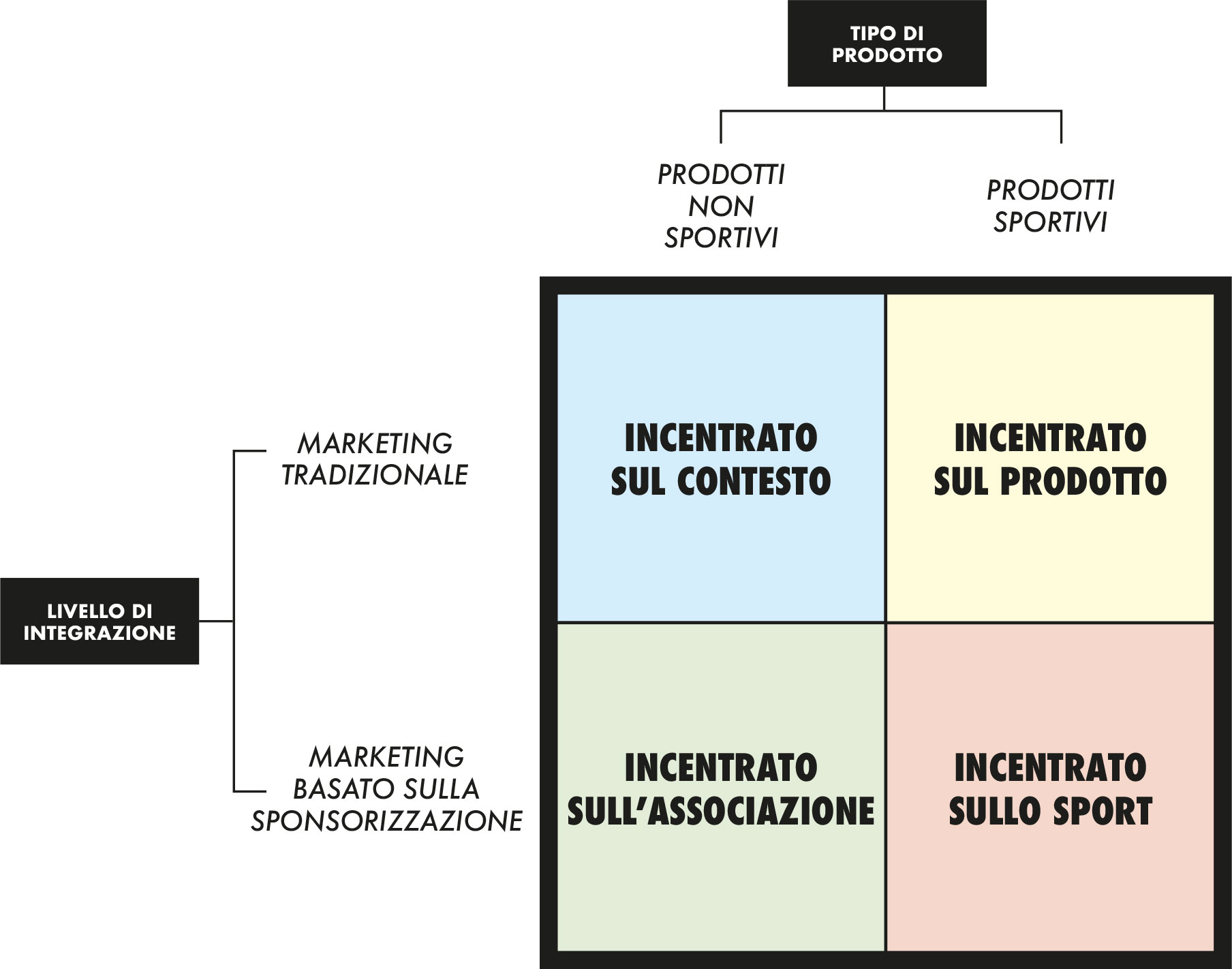
The most useful theoretical reference for finding your way through it remains the one set out by Sam Fullerton and G. Russell Merz, published in 2008 in Sport Marketing Quarterly. The two authors propose a matrix that divides sports marketing into four domains, built on two variables: the type of product (sports or non-sports) and the level of integration (traditional marketing or sponsorship). Four quadrants, four different logics.
The geometry of the matrix
Before going through each domain in detail, it is worth understanding how the matrix is built. The horizontal axis holds two categories of product: non-sports products (a car, an insurance policy, a telecoms carrier, an energy drink brand) and sports products (a running shoe, a MotoGP team, a streaming subscription to the races). The vertical axis separates two levels of integration with the sports market: traditional marketing and sponsorship.
The four domains come out of the intersection of those two axes. None of them is “superior” to the others in the abstract: each one answers to specific objectives and specific contexts. The distinction matters all the same for anyone working in this industry, and for anyone who has to decide where a budget goes.
1. Theme-based sports marketing
The first domain is, by the authors’ own admission, the least sophisticated of the four: the intersection of non-sports products and traditional marketing. Here sport is not the message: it is simply a high-traffic arena, a popular backdrop inside which a brand decides to run conventional advertising.
The examples are immediate and widespread. A financial company buying advertising slots during the live broadcast of the Formula 1 Italian Grand Prix, a consumer electronics brand buying inventory in the MotoGP qualifying stream: the content of the message has nothing to do with sport as such. What justifies the investment is the context, the audience, the concentration of attention, the demographic profile of the viewer.
Back in 2008, Fullerton and Merz already pointed to this as the form of sports marketing with the weakest long-term prospects. The erosion of traditional television audiences, the fragmentation of digital channels and the growth of on-demand viewing are steadily eating into the advantage of the “where”, and moving strategic attention towards the “how” and the “with whom”.
2. Product-based sports marketing
When the objective is to sell, reposition or build brand awareness for a sports product through traditional marketing, we are in the second domain. The line between this and the ordinary running of a sports business is a thin one, and it is no accident that Fullerton and Merz recognise this domain as the historical origin of sports marketing as a discipline in its own right.
In MotoGP, Dorna’s decision to introduce the Sprint races in 2023 is a clear case: a structural reform of the weekend that is, in substance, an act of product marketing. The aim was to make every round denser with high-value television moments, to lift audience engagement and to raise the commercial value of each Grand Prix for partners and sponsors. The “MotoGP product” was updated to respond better to the needs of its own market.
The same holds for every pricing decision on the MotoGP VideoPass streaming subscription, for official merchandise campaigns, for ticketing strategies that adjust prices according to the historical attendance of each circuit. All of these are product-based sports marketing.
3. Alignment-based sports marketing
The third domain, the intersection of non-sports products and sponsorship strategies, is the one that most directly describes the daily work of an agency like RTR Sports Marketing, and it is also the most articulated of the four in conceptual terms.
The underlying principle is sponsorship: a brand that produces nothing intrinsically sporting associates itself with a sports property (a team, an athlete, an event, a federation) in order to draw commercial return, awareness or positioning in terms of values. In the formulation of Mullin, Hardy and Sutton, a standard reference in the sport marketing literature, it is the acquisition of rights to affiliate or associate with a product, a team, an organisation or an event, in return for monetary compensation or payment in goods and services, with the aim of deriving commercial, marketing or image benefit from that association.
The examples in contemporary motorsport are numerous and layered. Monster Energy as title sponsor of the Yamaha factory team through 2026 (from 2027 it moves its title sponsorship to Aprilia), Tissot as official timekeeper of MotoGP since 2001, Estrella Galicia with Marc Marquez through his Honda years: each agreement answers a different logic of value association, energy and adrenaline, precision and reliability, technical excellence. This is not advertising. It is acquiring a share of the cultural identity of a property and transferring it to your own brand over time.
If you are weighing up this kind of strategy for your company, our section on MotoGP sponsorship is a useful place to start in understanding costs, mechanisms and the opportunities for a return on investment.
Fullerton and Merz break this domain down into four sub-forms:
- Traditional sponsorship, the brand logo on the livery, on the leathers or in official communication (Repsol on Honda HRC from 1995 to 2024, Tissot as official timekeeper of MotoGP);
- Venue naming rights, the brand that gives its name to the facility or the event (from the Circuit de Catalunya to the many Grands Prix that carry the name of a local institutional sponsor);
- Endorsement, the rider as the brand’s testimonial (Marc Marquez and Repsol in his Honda years, Valentino Rossi and Monster Energy since 2009);
- Licensing, the production of merchandise and licensed goods carrying the official marks of the sports property (scale models, replica clothing, MotoGP or F1 branded accessories).
Useful as this internal classification is in teaching terms, in practice the forms overlap more and more often. A partner like Repsol at Honda HRC, until 2024, combined traditional sponsorship, rider endorsement and licensing on technical products all at once: keeping the categories apart has descriptive value for the theory, but not always for the real market.
4. Sports-based sports marketing
The fourth domain, the most recent and in some ways the most revealing of how the industry has evolved, sits at the intersection of sports products and sponsorship strategies. Here sport funds sport: a company that makes sports products becomes the sponsor of a sports property in order to gain visibility and a competitive edge over its rivals.
The term that has taken hold for this category is technical sponsor. Michelin as the exclusive tyre supplier in MotoGP through 2026 (Pirelli takes over from 2027), Dainese as partner for rider protection systems, Alpinestars with race suits and gloves: these companies are not simply “in the sports category”, they are MotoGP, in the sense that their presence is constitutive of the discipline itself at a technical and performance level.
Only a few decades ago this would have been unthinkable: teams bought their material from suppliers, weighing cost against technical quality. Today it is the sports goods companies that pay to be associated with the best properties. The mechanism has been turned completely on its head.
The most extreme example of that shift remains the partnership between Reebok and CrossFit, an apparel company that for almost a decade became the identifying brand of an entire global movement, thinning the line between sponsor and property until it almost disappeared. The same dynamic is already visible in motorsport: think of the relationship between Michelin and the technical format of MotoGP, where tyre specifications shape the development choices of the manufacturers and, in effect, the nature of the competition itself.
A framework for navigating what comes next
The Fullerton and Merz matrix, though it is almost twenty years old, still offers a remarkable sense of direction. Not because the market has stood still, quite the opposite, but because its fundamental variables, type of product and mode of integration, hold up under the pressure of time.
What is changing is how the weight is distributed across the four domains. Theme-based marketing is losing ground, inevitably, as traditional media erode. Product-based marketing is turning more and more into experience management. And alignment-based marketing, sponsorship in the fullest and most contemporary sense of the word, keeps gaining relevance as a lever for building value over the long term.
This is something that sponsors, agencies and sports properties can no longer ignore. And something that, in a market growing steadily more competitive and more fragmented, should now be put to work with a good deal more strategic awareness.

*Sam Fullerton, G. Russell Merz, "The Four Domains of Sports Marketing: A Conceptual Framework", Sport Marketing Quarterly, Volume 17, Number 2, 2008.
Frequently asked questions about the domains of sports marketing
According to the framework published in Sport Marketing Quarterly in 2008, the four domains are theme-based sports marketing (non-sports products plus traditional marketing), product-based (sports products plus traditional marketing), alignment-based (non-sports products plus sponsorship) and sports-based (sports products plus sponsorship, in other words the technical sponsor). They are told apart by the type of product and the level of integration with the world of sport.
Marketing 'of sport' (product-based) sets out to promote the sports product itself: tickets, streaming subscriptions, race formats, merchandise. Marketing 'through sport' (theme-based or alignment-based) uses sport instead as a platform to communicate a brand or product that has nothing to do with sport. The distinction is not merely academic: it changes the logic of the objectives, the KPIs and the budgets involved.
Sports sponsorship is the acquisition of association rights, in return for monetary compensation or payment in goods and services, arising from the association with a sports property (team, athlete, event, federation). It is considered the most developed form because, unlike contextual advertising, it creates a deep and lasting association of values between brand and property, with effects on brand equity, B2B relationships and activations that go well beyond immediate visibility.
A technical sponsor is a company that makes sports products and that funds or supports a sports property in order to gain visibility and competitive advantage. In MotoGP, typical examples are Michelin as exclusive tyre supplier (until the end of 2026, with Pirelli taking over from 2027), Dainese for rider protection systems and Alpinestars for race suits. Unlike a traditional sponsor, the technical supplier's brand is woven into the property at the level of performance, not only image.
A non-sports brand can associate itself with motorsport teams, riders or events in several ways: logo presence on the livery and on the suits, naming rights, rider endorsement, hospitality activations in the paddock or co-marketing campaigns. The return works differently depending on the form chosen, from mass brand awareness to direct business opportunities in the B2B setting of the paddock. In MotoGP in particular, there are scalable entry levels suited to very different budgets and objectives.