James Hunt, born in Belmont, Surrey, on 29 August 1947 and died in Wimbledon, London, on 15 June 1993, was a British Formula 1 driver and 1976 world champion with McLaren. In 92 Grands Prix, between 1973 and 1979, he won 10 races and took 14 pole positions. He won the title by one point over Niki Lauda at Fuji, retired in 1979 and died at 45 of a heart attack.
Updated October 2026.
On 24 October 1976, in heavy rain and with fog over the Fuji circuit, Niki Lauda came into the pits after two laps and retired, convinced that his life was worth more than a title. James Hunt finished third and won the championship by one point, 69 to 68. It is the end of one of the most debated seasons in Formula 1 history, and of that season Hunt became the story.
James Hunt at a glance
- Born in Belmont, Surrey, on 29 August 1947; died in Wimbledon, London, on 15 June 1993, aged 45.
- World champion in 1976 with McLaren, by one point over Niki Lauda (69 to 68).
- 92 Grands Prix between 1973 and 1979, 10 wins, 14 pole positions, 23 podiums.
- Teams: Hesketh (1973-1975), McLaren (1976-1978), Wolf (1979).
- Retired in 1979; from 1980 a BBC commentator alongside Murray Walker.
From his start at Hesketh (1973-1975)
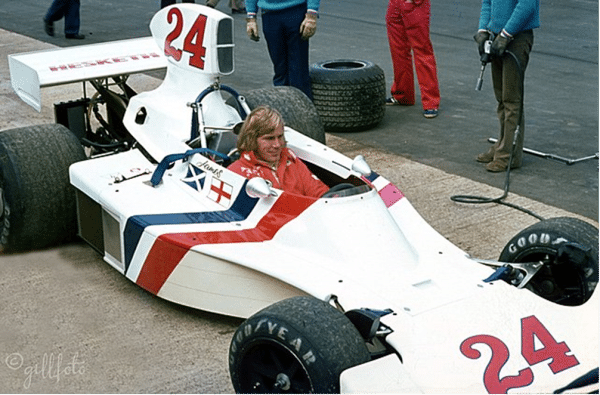
Hunt made his Formula 1 debut in 1973 at the Monaco Grand Prix with Hesketh, a private team funded by Lord Hesketh, in a March 731. He had made a name for himself with crashes in the junior formulae, earning the nickname “Hunt the Shunt” (a shunt is a collision). In F1 the results came quickly: fourth at the British Grand Prix, third at Zandvoort and second at Watkins Glen, in the last race of 1973. He finished eighth, with 14 points.
In 1974, with the Hesketh 308, he was eighth again, with 15 points, and won the International Trophy, a non-championship race. 1975 brought the first win: at Zandvoort he beat Lauda’s Ferrari, the championship leader, by one second, in the only victory in Hesketh’s history (Formula1.com). He finished fourth with 33 points. But Lord Hesketh had run out of funds and could not find a sponsor: the team was finished, and Hunt had no seat.
The McLaren seat and the 1976 season
The seat came up by chance. Emerson Fittipaldi left McLaren for his brother’s Copersucar team and the team, with no other big names available, signed Hunt for 1976, in a deal brokered by John Hogan of Marlboro. The first season with McLaren was the title one: eight pole positions and six wins in sixteen races.
1976 was also a season of overturned verdicts. In Spain Hunt crossed the line first but was disqualified, with the win given to Lauda; the decision was overturned on appeal months later. In Britain, at Brands Hatch on 18 July, a crash at the start and the red flag left Hunt out of the restart: the crowd demanded his return, the stewards gave way and he won. Ferrari, Tyrrell and Copersucar protested and, in late September, a tribunal disqualified him for “outside assistance”, awarding the win to Lauda.
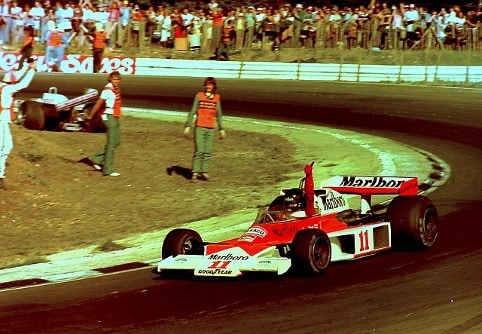
The title: Lauda, the Nürburgring and Fuji
On 1 August 1976, at the Nürburgring, Lauda’s Ferrari caught fire: the Austrian, who was leading the championship, suffered severe burns and inhaled toxic fumes. Hunt won that Grand Prix. Lauda missed two races and returned at Monza on 12 September.
The season was decided at the last Grand Prix, on 24 October at Fuji, on a wet track shrouded in fog. Lauda retired after two laps; Hunt finished third and won the title with 69 points to 68, the smallest margin in the previous eight years.
One point, in a season in which two of Hunt’s wins were first cancelled at the table and only one was later given back.
After the title: McLaren, Wolf and retirement (1977-1979)
In 1977, still with McLaren, Hunt won three races (Silverstone, Watkins Glen and Fuji) and was fifth with 40 points; in 1978, again with McLaren, he was thirteenth with 8 points. In 1979 he moved to Wolf and ran seven races without scoring. He retired at the Monaco Grand Prix, with a broken driveshaft, and announced his farewell to racing on 8 June 1979.
He later explained that he left out of self-preservation (Formula1.com). He was 31.
After racing: the BBC commentator
From 1980 Hunt was the BBC commentator alongside Murray Walker, a role he kept until his death. Formula1.com describes him as a respected, outspoken commentator able to argue his case.
His death
James Hunt died on 15 June 1993 in Wimbledon, London, of a heart attack, aged 45. A few hours earlier he had asked Helen to marry him (Formula1.com).
James Hunt in numbers
- 92 Grands Prix (1973-1979).
- 10 wins, 14 pole positions, 23 podiums, 179 points.
- 1976: 16 races, 6 wins, 8 pole positions, 69 points, champion by one point.
- One world title, in 1976 with McLaren.
To place Hunt in a ranking, see our guide to the greatest Formula 1 drivers of all time; for the other half of that story, the profile of Niki Lauda. The 1976 rivalry is also the subject of the film Rush (2013), in which Hunt is played by Chris Hemsworth. And those who want to understand what it means to put their brand on a champion’s car will find a starting point on the page about Formula 1 sponsorship.
To remember Hunt only for the partying is to miss the point. Sixteen races, two wins taken away at the table, a rival who retired fearing for his life and a title won in the rain at Fuji. One point.
RTR Sports Marketing has been building motorsport sponsorships since 1995.
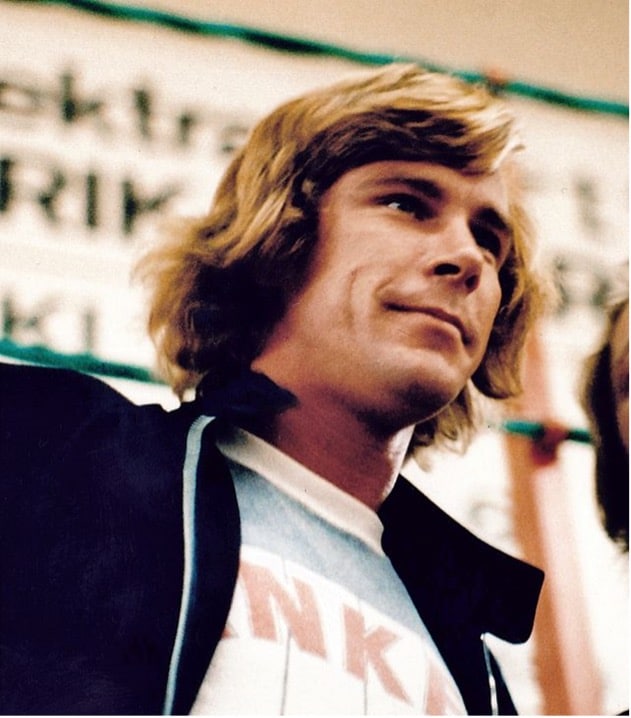
Images, from the top: James Hunt at a press conference before the 1977 Swedish Grand Prix (Mr.choppers, Creative Commons Attribution-Share Alike 3.0); James Hunt in the Hesketh at Brands Hatch, Race of Champions, England, 1974 (Gillfoto, Creative Commons Attribution-Share Alike 3.0); James Hunt celebrating prematurely at the 1976 British Grand Prix (Martin Lee, Creative Commons Attribution-Share Alike 2.0).
Sources: Wikipedia, James Hunt; Wikipedia, 1976 Formula One season; Wikipedia, 1976 British Grand Prix; Wikipedia, 1976 Japanese Grand Prix; Formula1.com, James Hunt in the Hall of Fame; Forix, James Hunt profile; Formula1.com, Hesketh’s win at Zandvoort.
Frequently asked questions
Who was James Hunt?
A British Formula 1 driver, born in Belmont, Surrey, on 29 August 1947 and died in Wimbledon on 15 June 1993. He was world champion in 1976 with McLaren, after racing for Hesketh and Wolf, and later a BBC commentator.
How many times was James Hunt world champion?
Once, in 1976 with McLaren, with 69 points to Niki Lauda’s 68. In 92 Grands Prix he won 10 races and took 14 pole positions.
How did James Hunt die?
Of a heart attack, on 15 June 1993 in Wimbledon, London, aged 45. A few hours earlier he had asked Helen to marry him.
When and where was James Hunt born?
On 29 August 1947 in Belmont, Surrey, England.
How did James Hunt win the 1976 title?
At the last Grand Prix, on 24 October at Fuji, in the rain: Lauda retired after two laps and Hunt, third, won the title by one point, 69 to 68.
Which film tells the story of James Hunt?
Rush (2013), which tells the rivalry between Hunt and Niki Lauda in 1976. Hunt is played by Chris Hemsworth.