The price of a MotoGP suit tells only part of the story. In the shops, high-end racing suits range from about 2,240 euros for the Alpinestars GP Tech V5 to about 3,600 euros for the Alpinestars Racing Absolute V2, the base from which riders’ suits are made, both sold without an airbag; the Dainese Mugello 3 Perf D-air, with an integrated airbag, came out in 2024 at 4,449.95 euros. A rider’s MotoGP suit, on the other hand, has no price list: it is made to measure, a rider has at least four of them available at every Grand Prix, and after a crash it is repaired at the track whenever possible.
The more interesting part is what that suit actually does. In my view, the most useful way to look at it is this: a MotoGP suit is the rider’s black box. It protects the person wearing it, it records what happens and, when it is all over, it is the thing still standing in front of the cameras. For a sponsor, it is the third point that makes the difference.
How a MotoGP suit is made
The base is a one-piece leather suit, because leather remains the benchmark material against abrasion on tarmac: manufacturers consider it superior to any synthetic textile. Kangaroo leather is the main material, sometimes combined with cowhide, with a double layer in the areas most exposed to abrasion: elbows, forearms, seat, hips and back. Kangaroo leather has a specific advantage: according to Ducati’s figures it is about 0.9 millimetres thick, 25% thinner than the cowhide used for sports suits, and one square metre weighs about 600 grams.
The figure that best explains the craftsmanship comes from Alpinestars: one of its production racing suits starts from a paper pattern of around 80 pieces of kangaroo leather, to which around 75 components are added, from protectors to stitching and Kevlar inserts. A rider’s suit starts from there and is adapted to their body and riding style.
On the outside are the sliders, the replaceable inserts that scrape along the tarmac: on the knees, the elbows and the shoulders. For years they were mostly a matter of knees; today the elbow sliders count just as much, and Alpinestars prepares three different, interchangeable compounds for them. On the inside are the protectors for knees, shoulders, elbows, forearms, back and tailbone.
The airbag: mandatory since 2018
Since 2018, by decision of the Grand Prix Commission, which brings together the FIM, Dorna, the teams and the manufacturers, an airbag suit has been mandatory in all three classes, MotoGP, Moto2 and Moto3: every rider must start every session with a working airbag, and since mid-2018 the requirement has also applied to wildcards. The rules require the airbag to protect at least the shoulders and collarbones, to need no additional parts on the bike and to deploy without the rider being tethered to the machine. Many riders had already been using one for years; from then on, it was no longer a choice.
The system works with a network of sensors and an algorithm that recognises a crash. According to the official MotoGP website, the airbag can inflate in as little as 0.045 seconds from the start of the crash and is designed to protect the chest, shoulders, ribcage, upper back and neck. The two names you meet most often in the paddock are Alpinestars’ Tech-Air and Dainese’s D-air, both Italian companies: the first was founded in Asolo in 1963, the second in Molvena in 1972.
The hump: aerodynamics, water and data
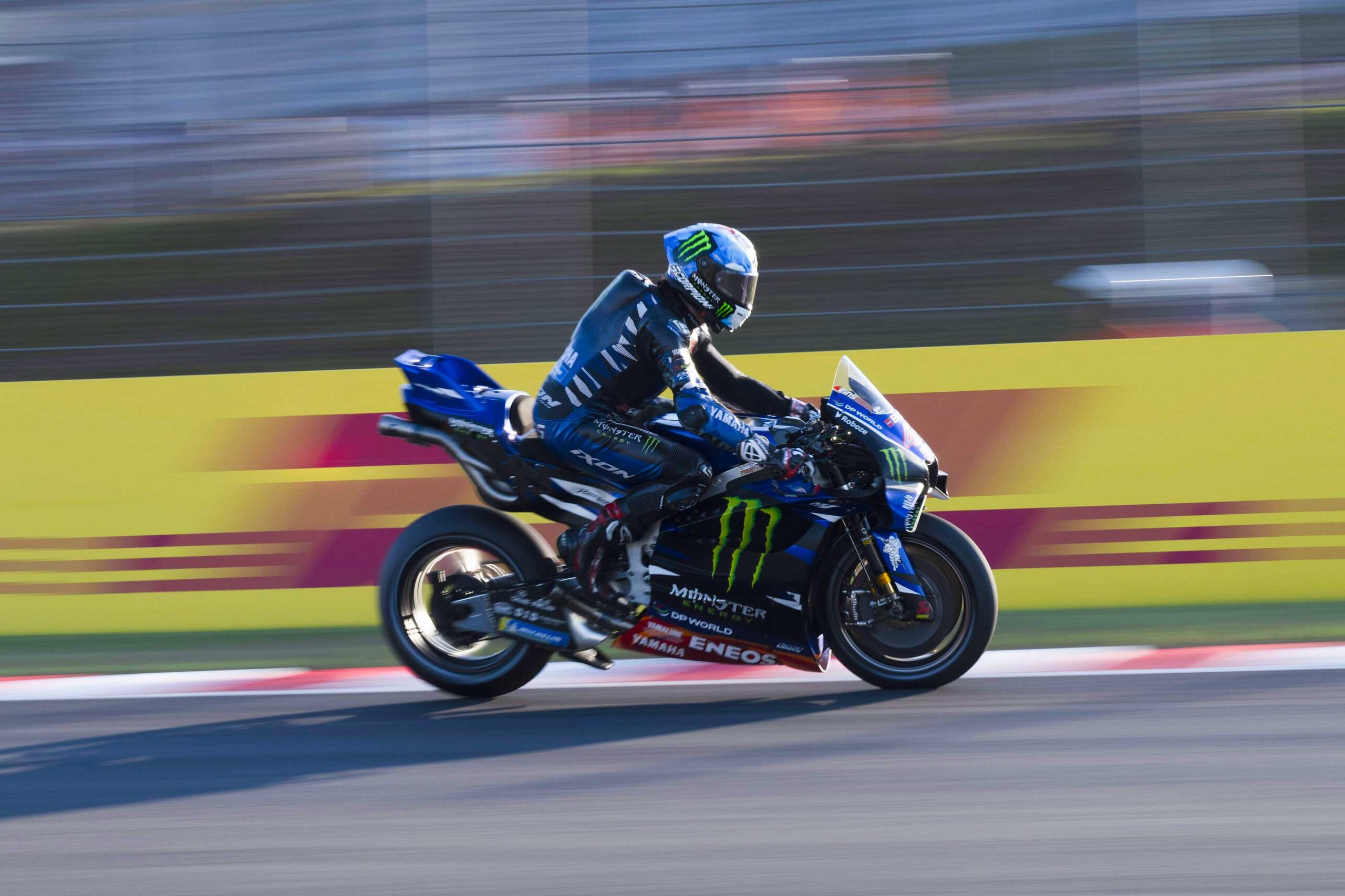
The hump on riders’ backs first appeared in 1988 on Dainese suits, and the first rider to race with it was Pierfrancesco Chili. It was created to protect the upper back; a few years later riders realised that, tucked in behind the fairing, it made the head more stable at high speed, and since then it has also been an aerodynamic element. Today it is shaped around each rider’s helmet and spoiler, and inside it houses the water bladder, the airbag electronics and the data loggers.
That is why the black box image is no exaggeration. The airbag electronics record the sensor data during crashes, and manufacturers use it to refine the algorithm that decides when to inflate.
Heat, crashes and four hours inside the leather
In 2024 the MotoGP class recorded 335 crashes over 20 race weekends, an average of 16.8 per Grand Prix, against 358 in 2023. Every crash means a suit to check. That is why Alpinestars, for example, gives every rider at least four suits at each Grand Prix and works in the paddock with a mobile workshop, seamstress included: many repairs are done there, the rest goes back to Italy, and if the damage is too extensive the suit is made again from scratch.
Then there is the heat. A rider who makes the podium stays inside their suit for the better part of four hours, between the race, the ceremony and the interviews. At the first Grand Prix of 2025, in Thailand, with temperatures close to 40 degrees, the Red Bull KTM Tech3 riders were feeling the heat from the bike: after the Sprint, Alpinestars added to their suits, in some areas, the same heat-resistant material it sometimes uses in boots near the exhaust. The undersuit, which manages sweat and temperature, is as much a part of the system as the leather.
Anyone who knows the Formula 1 race suit will notice the fundamental difference: there, the first enemy is fire; here, it is the tarmac. We covered it in our guide to the F1 driver’s race suit.
How much does a MotoGP suit cost
In numbers: for an enthusiast, the reference figure ranges from about 2,240 euros for an Alpinestars GP Tech V5 to about 3,600 euros for an Alpinestars Racing Absolute V2, the production suit from which riders’ suits are made; both are airbag-ready but sold without one. With an integrated airbag, the Dainese Mugello 3 Perf D-air came out in 2024 at 4,449.95 euros and now sells for about 4,500. Shop prices change with promotions, but that is the order of magnitude.
For a rider, the bill is a different matter, and it is not public. The suit is part of the contract with the manufacturer, it is made to measure, at least four are prepared for every weekend and it is repaired constantly. Anyone who gives you a precise price for a MotoGP rider’s suit is, in my view, guessing.
Why the suit matters to a sponsor
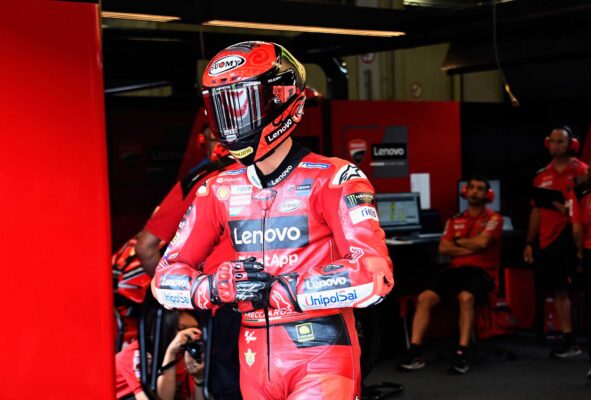
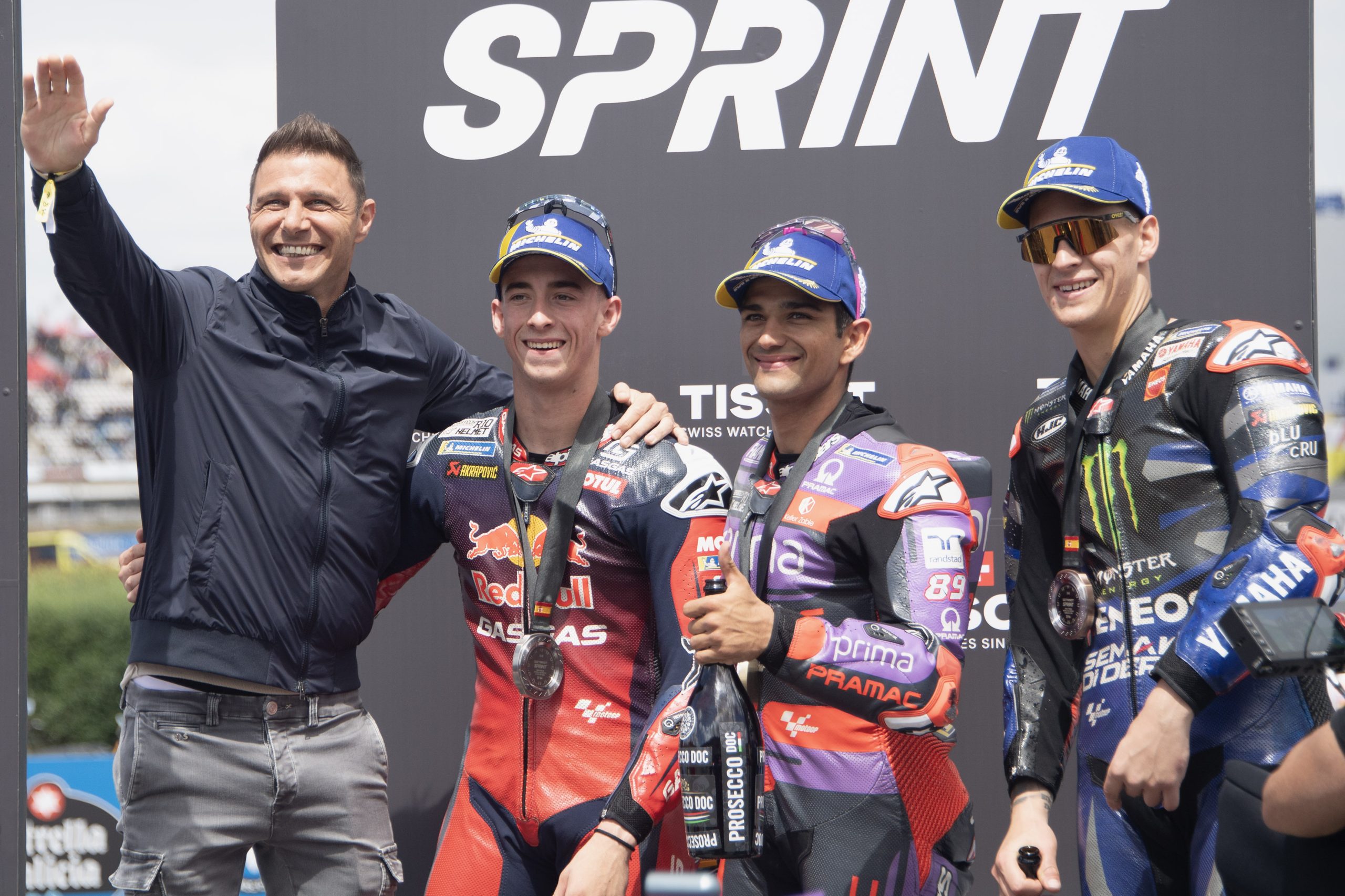
The bike does not go up on the podium. The suit does, and the logos with it: it is the suit that is seen on the grid, in the interviews, in the photos doing the rounds on Monday morning. That is why a rider’s chest, shoulders, arms and legs are highly sought-after commercial space, shared between the team’s sponsors and the rider’s personal ones.
In my work I often see the same scene: a brand buys a logo on the suit and thinks it has bought the rider. It has not. The logo is the beginning. What you can sponsor in MotoGP, and at what cost, we explained in our guide to rider, team, race or championship; how to build a brief by category, with concrete examples for energy drinks, fintech and aftermarket, in our article on three MotoGP sponsorship briefs.
The most common traps for a brand on the suit
One, treating the suit as a space to fill. A logo without a programme around it remains what it is: an empty sticker on a uniform.
Two, choosing the position by looking at the mock-up rather than the pictures. A suit is seen mostly when the rider is standing still: in the garage, on the grid, on the podium. Those are the moments worth planning around.
Three, forgetting image rights. A logo on the suit does not automatically give you the right to use the rider in your own campaigns: that has to be negotiated, and it is often the most valuable part.
If you are considering a MotoGP sponsorship, on the suit, on the bike or across the whole team, our page on MotoGP sponsorships explains how we work.
The suit protects the rider. The programme protects the investment. Always.
Frequently asked questions about the MotoGP suit
How much does a MotoGP suit cost?
In the shops, high-end racing suits range from about 2,240 euros for the Alpinestars GP Tech V5 to about 3,600 euros for the Alpinestars Racing Absolute V2, both without an airbag; the Dainese Mugello 3 Perf D-air with an integrated airbag came out in 2024 at 4,449.95 euros. Riders’ suits are made to measure and are part of their contracts with the manufacturers: their cost is not public.
What is a MotoGP suit made of?
It is a one-piece leather suit, mostly kangaroo leather, sometimes combined with cowhide, with inserts in synthetic materials such as Kevlar. An Alpinestars racing suit starts from around 80 pieces of kangaroo leather and around 75 components, from protectors to stitching and inserts.
Do MotoGP riders' suits have an airbag?
Yes. Since 2018 the airbag has been mandatory in MotoGP, Moto2 and Moto3: every rider must start every session with a working airbag. It must protect at least the shoulders and collarbones and, according to the official MotoGP website, it can inflate in as little as 0.045 seconds from the start of a crash.
What is the hump on MotoGP riders' suits for?
It first appeared in 1988 on Dainese suits to protect the upper back; riders later discovered that it also improved aerodynamics. Today it also contains the water bladder, the airbag electronics and the data loggers.
Who makes MotoGP riders' suits?
The suits are made to measure by technical clothing manufacturers, above all Alpinestars and Dainese, two Italian companies founded in Asolo in 1963 and in Molvena in 1972 respectively. Alpinestars riders, for example, have at least four suits available at every Grand Prix.
Why do MotoGP riders have sliders on their elbows?
Because at the most extreme lean angles it is not only the knee that touches the ground: the elbow and shoulder can also scrape the tarmac. Sliders are replaceable inserts that protect the suit and help the rider feel the lean angle.