In June 2022 Formula 1 had just brought ground effect back, and the cars, sucked down onto the track, left trails of sparks behind them that had not been seen like that for years. I wrote this article at the time to explain where they come from and why Formula 1 chose to keep them. We are republishing it as it was, with an update, because a lot has changed in four years: the rules on the floor, disqualifications for worn floors, even a problem with grass fires, and in 2026 an entirely new generation of cars.
Updated September 2026.
In short: the sparks come from the metal skids fitted under the floor of the car, which rub against the tarmac when the car is pressed down by aerodynamic load or by compressions in the track. Since 2015 they have been made of titanium, chosen by the FIA mainly for safety reasons, with the spectacle as a side effect appreciated by television and photographers. The floor wears and is measured after every race: in 2025 drivers disqualified for an over-worn floor included Lewis Hamilton in China and both McLarens in Las Vegas. Under the 2026 rules the skids are still mandatory, so Formula 1 cars still spark.
The June 2022 article
The success, recent and past, of Formula 1 has a lot to do with the appeal of the cars and of those who drive them. These extraordinary marvels of engineering (and their fearless pilots) have always held a place of honour in the dreams and fantasies of young and not-so-young lovers of speed, engines and everything to do with the automotive industry. It is no coincidence that one of the first adjectives associated with the Circus is “aspirational”: Ferrari, for example, is not considered just a racing team. “Everyone supports Ferrari”, to quote four-time world champion Sebastian Vettel.
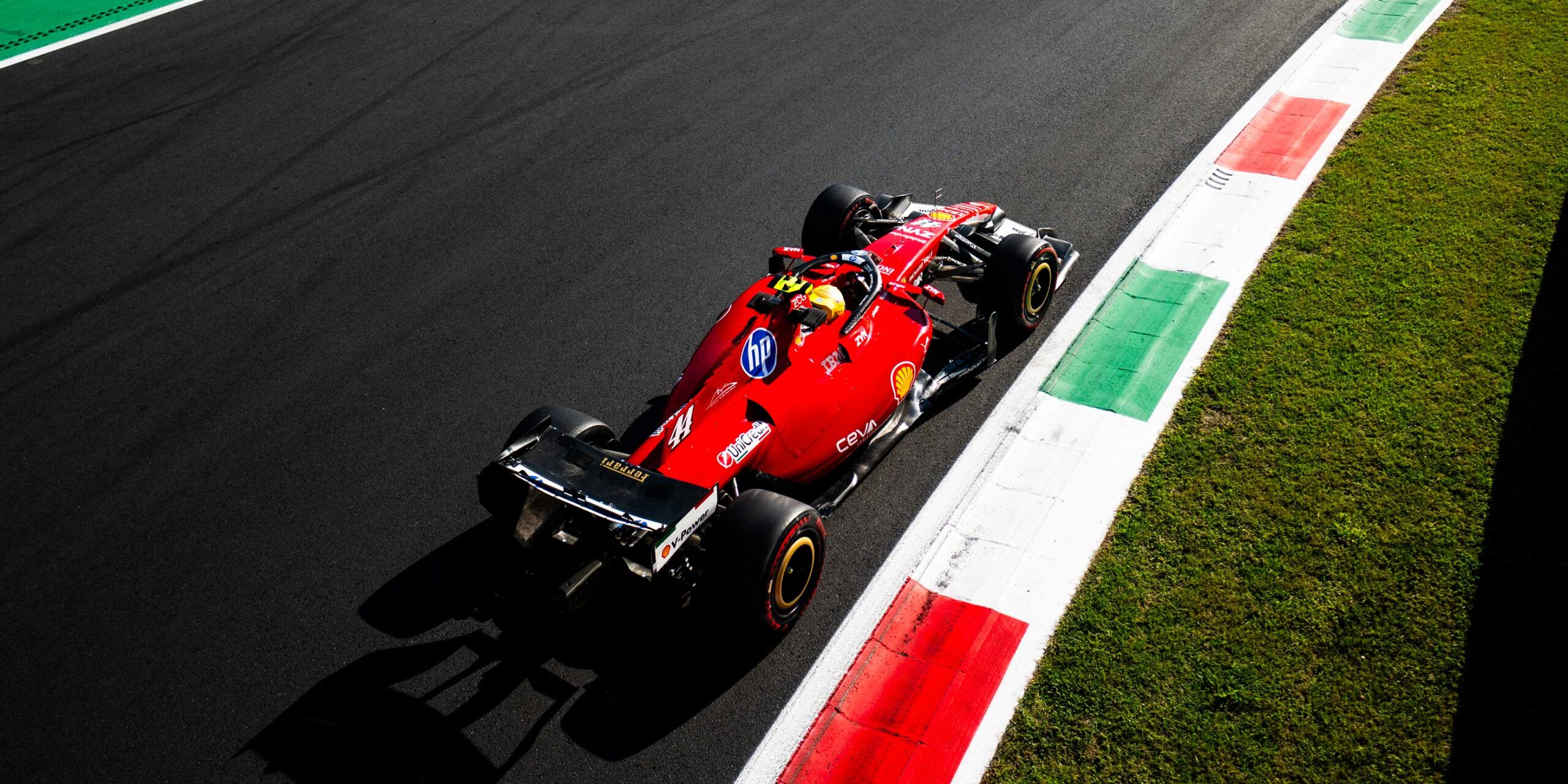
In this spectacular imagery, well represented by a wealth of posters, stickers, calendars and double-page newspaper spreads, a special place is held by the trails of sparks that Formula 1 cars leave in their wake. These luminous tongues that shoot out from under the cars and that contribute to the great “aesthetic” appeal of the sport are in fact based on a series of reasons, some engineering, some regulatory, that explain their presence.
As always in the world of Formula 1, nothing happens without a reason in this case either. And although it may seem a detail, behind every nuance of this incredible sport there is always a story. In short, there is a very precise answer to the question “why do Formula 1 cars spark?”.
The magic of four wheels
As is obvious, F1 cars are far removed from ordinary everyday cars. Besides engine performance, a fundamental role is played by the aerodynamic load these cars can generate, which allows them extraordinary cornering speeds.
Many elements contribute to downforce on a Formula 1 car but, to simplify, we can say that the main ones are the wings and the floor of the car. The latter, thanks to a change in the regulations, has returned to the centre of Formula 1 design interest because of the reintroduction of the infamous ground effect, which had disappeared from the scene for more than twenty years.
It is from the floor of the car, an extremely complex area, that the sparks are generated.
The sparks are caused by the titanium plates that protect the car’s floor when they rub against the tarmac at high speed. The floor is made of a wood-like material (known as Jabroc, to be precise), designed to be both efficient in terms of weight and compliant with the regulations. At the end of each race, the floor is in fact measured to make sure it has not worn down by more than one millimetre. The purpose is to check that the car has not run too low during the race and that it complies with the regulatory parameters. Otherwise, disqualification follows. Since, unlike the wood, the titanium plates that support the floor do not wear down, the millimetric gap between the floor and the plates determines whether or not a set-up is compliant with the rules.
The contact of the metal blades with the track creates friction in situations of high aerodynamic load, when the car is “squashed” to the ground by air pressure.
Over the history of F1, this particular “special effect” has been the subject of changes aimed at accentuating it even more: in the 2015 season the so-called skid blocks were introduced, “skates” placed on the floor with the sole purpose of recreating the spectacular trails of light of the 80s and 90s cars. Titanium was chosen both for its lightness and strength and for its spectacular effect. That year F1 realised that those sparks were important for fans, television and photographers, so technological solutions were adopted to allow them.
The combination of interests chosen by the federation is interesting: on the one hand spectacle and on the other safety, reaching the happy conclusion that one does not exclude the other. Could they have made a Formula 1 without sparks? Yes. There are technological solutions that would let the cars avoid them, but a conscious choice was made that they are good for everyone.
Do sparks damage the car?
The answer is: exactly the opposite. The titanium plates serve to protect the underside of the car from any debris on the track that could damage the internal mechanical parts.
However, with the reintroduction in the 2022 season of the flat floor with Venturi tunnels and the already mentioned ground effect, teams have had to (and still have to) deal with porpoising and bouncing. What are they?
The last time a Formula 1 car exploited ground effect was 1983. Airflows are channelled under the car, through the Venturi tunnels, to create downforce and push the car down at high speed. The famous porpoising occurs when there is no more space between the floor of the car and the tarmac, and the new area of air pressure causes the car to rise. At that point the Venturi tunnels step in again and bring the car back down (our more technical readers will forgive these “light” scientific explanations). This up-and-down effect does no good either to the car, putting heavy stress on the suspension and chassis, or to the driver.
Bouncing is often grouped with porpoising, although it has some different characteristics. In this case the effect is more likely on tracks that are not particularly flat, with many “wavy” sections (as in Baku). The FIA has spoken out on the matter, deciding to take measures to protect the drivers’ health. These two effects make driving uncomfortable, with consequences for the athlete’s physical condition (as happened mainly to seven-time world champion Lewis Hamilton throughout the first part of the 2022 season in Formula 1).
As already mentioned, the relationship between spectacle and safety works in most of the technological solutions adopted in the top championship on four wheels. Just think of the lives saved by the introduction of the HALO, protecting the cockpit, or the more adrenaline-fuelled DRS (drag reduction system), introduced to increase the number of overtaking opportunities during a race. Innovation has also carved out its space with the hybrid era, and the introduction of ERS (energy recovery system), combined with the performance of the combustion engine, is proof of that.
Four years later: what has changed
Rereading an article a few years on is also a way of correcting it. Here is what we know today, and what has happened to Formula 1 floors from 2022 to 2026.
Two clarifications on the 2022 text
The first concerns the origin of the skids. The wooden floor, the so-called plank, and the metal skids that protect it have existed since 1994: they were not introduced in 2015, it was the material that changed. Titanium replaced tungsten, a much heavier metal that could come loose and become a dangerous projectile for following drivers. The FIA explained at the time that the reason for the choice was safety, and that the more visible sparks were a side effect, certainly welcomed by television and photographers, but not the goal.
The second concerns wear. Titanium skids wear too: the FIA estimated that they would wear two to two and a half times faster than the previous material. This is why the regulations do not only measure the wood, but the overall thickness of the floor at specific points, around holes drilled into the plank for this purpose.
Disqualifications for worn floors
Until 2025 the plank had to be 10 millimetres thick, with a minimum of 9 millimetres accepted at the end of a race. It is a rule that affects results far more than people think. At the 2023 United States Grand Prix, Lewis Hamilton and Charles Leclerc were disqualified. In 2025 it happened to Nico Hülkenberg in Bahrain, to Hamilton in China and, in Las Vegas, to both McLarens of Lando Norris and Oscar Piastri, with the team blaming the wear on porpoising. In a championship later decided by a handful of points, as the 2025 title was, one millimetre of wood can make the difference.
Sparks and fires: the Suzuka case
In 2025 the sparks also became a problem. During second practice at the Japanese Grand Prix at Suzuka, sparks from the skids set fire to the grass beside the track, forcing the session to be stopped several times. The FIA had stainless steel skids tested in practice at the Spanish Grand Prix and then decided to keep titanium, but requiring teams to have steel skids ready at every race, to be fitted if the federation asks for them.
2026: new cars, skids still in place
In 2026 Formula 1 changed generation. The cars are smaller and lighter, with a minimum weight of 768 kilograms, a wheelbase of 3,400 millimetres and a width of 1,900 millimetres, and they use moving front and rear wings. The Venturi tunnels of 2022 have been abandoned in favour of flatter floors that are less sensitive to ride height and porpoising. DRS no longer exists: it has been replaced by active aerodynamics and Overtake Mode, which gives extra electrical energy to the chasing driver. We cover this in our Formula 1 glossary.
The floor, however, remains. The 2026 technical regulations still require a 10 millimetre plank, with a minimum of 8 millimetres, and a mandatory metal skid around the front measuring hole. The skids can be made of a titanium alloy or of stainless steel, and the FIA decides race by race which material is to be used. In other words: as long as the skids touch the tarmac, Formula 1 cars will keep sparking.
Why sparks matter for marketers too
Four years on, the starting point of this article still holds: Formula 1 sells an imagery, and the night-time sparks of Singapore or Las Vegas are among its most recognisable images. For a brand that chooses Formula 1, the association with that spectacle is part of the value. If you want to understand how to make the most of it, start from our page on Formula 1 sponsorship or contact us.
Sources: Motorsport.com, the FIA on titanium skids; Autosport, why Formula 1 cars spark; Formula 1, the Austin 2023 disqualifications; Formula 1, the 2025 Chinese GP disqualifications; RaceFans, Hülkenberg’s disqualification in Bahrain; Formula 1, the McLaren disqualification in Las Vegas; Autosport, the Suzuka fires; RaceFans, the steel skid rule; The Race, titanium stays; FIA, 2026 technical regulations; Formula 1, the 2026 cars; Motorsport.com, the floor of the 2026 cars; Motorsport.com, the porpoising countermeasures.
Frequently asked questions about Formula 1 sparks
Why do Formula 1 cars spark?
The sparks come from the metal skids fitted under the floor of the car, which rub against the tarmac when the car is pressed down by aerodynamic load or by compressions in the track. Since 2015 the skids have been made of titanium, which produces far more visible sparks than the tungsten used previously.
Why did the FIA choose titanium for the skids?
For safety reasons: tungsten was much heavier, and a piece that came loose could be dangerous for following drivers. The more spectacular sparks are a side effect appreciated by television and photographers, not the reason for the choice.
Do sparks damage a Formula 1 car?
No, the skids are there precisely to protect the floor of the car. But the floor wears and is measured at the end of the race: if it is below the minimum thickness the car is disqualified, as happened to Hamilton and Leclerc in Austin in 2023 and to both McLarens in Las Vegas in 2025.
Do 2026 Formula 1 cars still spark?
Yes. Under the 2026 rules the floor must still have a mandatory metal skid, made of titanium or stainless steel as decided by the FIA race by race, so contact with the tarmac continues to produce sparks.
What happened with the Suzuka fires?
In practice at the 2025 Japanese Grand Prix, sparks from the skids set fire to the grass beside the track. The FIA tested steel skids, decided to keep titanium and required teams to have steel skids ready at every race.